Every manufacturing plant with machinery between 12 and 25 years old eventually confronts the “mechanically sound, electronically obsolete” dilemma: a heavy cast-iron or welded stainless-steel packaging machine whose base frame, conjugate cams, and multi-SKU format tooling still hold micron-level tolerances, but whose discontinued PLC, motion drives, and operator terminal halt production for days whenever an aged circuit board fails. Structuring a capital expenditure approval (CAR or AFE) to resolve this bottleneck requires a rigorous engineering and financial comparison of a PLC retrofit vs new machine replacement. When a station passes a quantitative 7-Point Mechanical Prerequisite Audit (cam runout <= 0.05–0.12 mm TIR, planetary gearbox backlash <= 5–8 arcminutes, and ISO 10816-3 bearing vibration <= 1.4–2.3 mm/s RMS), executing a legacy control system upgrade (UL 508A subplate, EtherNet/IP CIP Motion or EtherCAT servos, ISO 13849-1 PL d functional safety, and ISA-TR88.00.02 PackML integration) at 30% to 45% of new-machine Total Installed Cost (TIC) extends economic asset life by 7 to 12 years, reuses 100% of existing SKU change-part tooling (saving USD 40,000 to USD 150,000), compresses delivery lead time from 24–40 weeks down to 6–10 weeks, and achieves discounted payback in 1.5 to 2.5 years.
Where our parent station-modernization overview on questions that differ when you retrofit or replace a station introduces the qualitative contrast across signal interface ownership, validation scope, and plant stop windows within the factory automation workflow—and our cross-cluster manufacturing equipment CapEx budget template establishes the general 8-Bucket Total Installed Cost (TIC) Work Breakdown Structure (Lang Factor 1.45x to 1.95x)—this technical and financial reference provides the brownfield mechanical inspection tolerances, OEM obsolescence risk equations, UL 508A / NFPA 79 / ISO 13849-1 safety compliance rules, 26 CFR § 1.263(a)-3 capitalization tests, and side-by-side 5-year Discounted Cash Flow (DCF) math (USD 245,000 PLC/servo retrofit vs. USD 680,000 new horizontal cartoner).
| Evaluation Dimension & Gate | Option A: Legacy Control System Upgrade (PLC & Servo Retrofit) |
Option B: New OEM Machine Replacement (100% Turnkey Station) |
CFO & Engineering Decision Rule (PLC Retrofit vs New Machine) |
|---|---|---|---|
Total Installed Cost (TIC) & Retrofit Cost Ratio (R_retrofit) |
25% – 45% of New Machine TIC (USD 245,000 / 36.0% TIC in worked cartoner model, including 19.8% Tier C brownfield contingency) |
100.0% Reference TIC (USD 680,000 in worked model = USD 420k base OEM frame + USD 90k tooling + USD 170k ancillary WBS) |
Green Light Retrofit (Zone 1) when R_retrofit <= 45% and mechanical audit passes; Replace (Zone 3) when R_retrofit >= 58% |
Multi-SKU Format Change Parts (Starwheels, Collars, Magazines) |
Reuses 100% of existing change-part sets at USD 0 capital cost (preserves USD 40,000–USD 150,000 in proven SKU tooling) |
Must repurchase 100% of extra SKU tooling (USD 8,000–USD 35,000/set) because legacy tooling rarely fits a new OEM model pitch |
Tooling reuse alone frequently accounts for 12% to 22% of the capital savings in a brownfield controls retrofit |
| Supply-Chain Lead Time & Pre-Cutover Obsolescence Exposure | 6 to 10 weeks off-site panel build & bench FAT (limits ongoing legacy breakdown exposure to ~2 months) |
24 to 40 weeks (6–10 months) OEM build queue + ocean freight (exposes plant to 6+ extra months of legacy downtime bleed) |
Every extra month waiting for a new machine costs E[C_obsolescence] / 12 (~USD 15,833/mo in worked cartoner case) |
| On-Site Plant Shutdown & Cutover Outage Window | 2 to 4 days (Swing-Arm I/O Adapter) or 5 to 10 days (Full UL 508A Subplate + Multi-Axis Servo Swap) |
10 to 21 days (demolish & rig out legacy frame, slab anchor Prep, rig in new frame, re-pipe utilities, multi-SKU SAT) |
Verify finished-goods buffer inventory or temporary co-packing toll coverage for any outage exceeding 5 days |
Mechanical Prerequisite Gate (Frame, Cams, Reducers, Bearings) |
Requires <= 0.12 mm TIR cam runout, <= 8 arcmin indexing gearbox backlash, and <= 2.3 mm/s RMS vibration (ISO 10816-3) |
Replaces 100% of frame weldments, conjugate cams, gearboxes, bearings, and linear rails under a new 12–24 month OEM warranty |
Hard Disqualifier: Never mount modern 0.25 ms servo loops onto a cracked frame or spalled barrel cam (> 0.25 mm wear) |
| Safety, Electrical & OT Network Compliance Scope | Upgrades panel to UL 508A 25–65 kAIC SCCR, ISO 13849-1 PL d / Cat 3 with Drive STO, IEC 62443 NAT firewall, and PackML OPC UA |
Supplied factory-compliant by OEM to current ISO 13849-1 PL d, NFPA 79, UL 508A, and OPC UA PackML specifications |
Under OSHA 29 CFR § 1910.212 / § 1910.303 & NFPA 79, a control retrofit must bring safety & panel SCCR to current code |
Statutory Tax & Accounting Treatment (26 CFR § 1.263(a)-3 & IAS 16) |
Capitalize (CapEx Basis B_ret) as a Restoration (§ 1.263(a)-3(k)) or Betterment (§ 1.263(a)-3(j)); depreciate over 7-Yr MACRS; expense training |
Capitalize (CapEx Basis B_new) under ASC 360-10-30 / IAS 16.16; derecognize scrapped machine (IAS 16.70); expense training |
Single 1:1 emergency module swaps are expensed as OpEx repairs (§ 1.263(a)-3(i)), whereas full panel retrofits are capitalized |
The 30 to 45 percent decision gate: PLC retrofit versus new machine
When plant engineering brings a legacy control system upgrade proposal to the corporate Investment Committee, the Chief Financial Officer (CFO) and Vice President of Operations test whether investing capital into an existing 15-to-20-year-old mechanical asset creates more risk-adjusted value than retiring the station and buying a new machine. Answering that question requires evaluating a two-stage engineering and financial gate before releasing Front-End Engineering Design (FEED) funds.
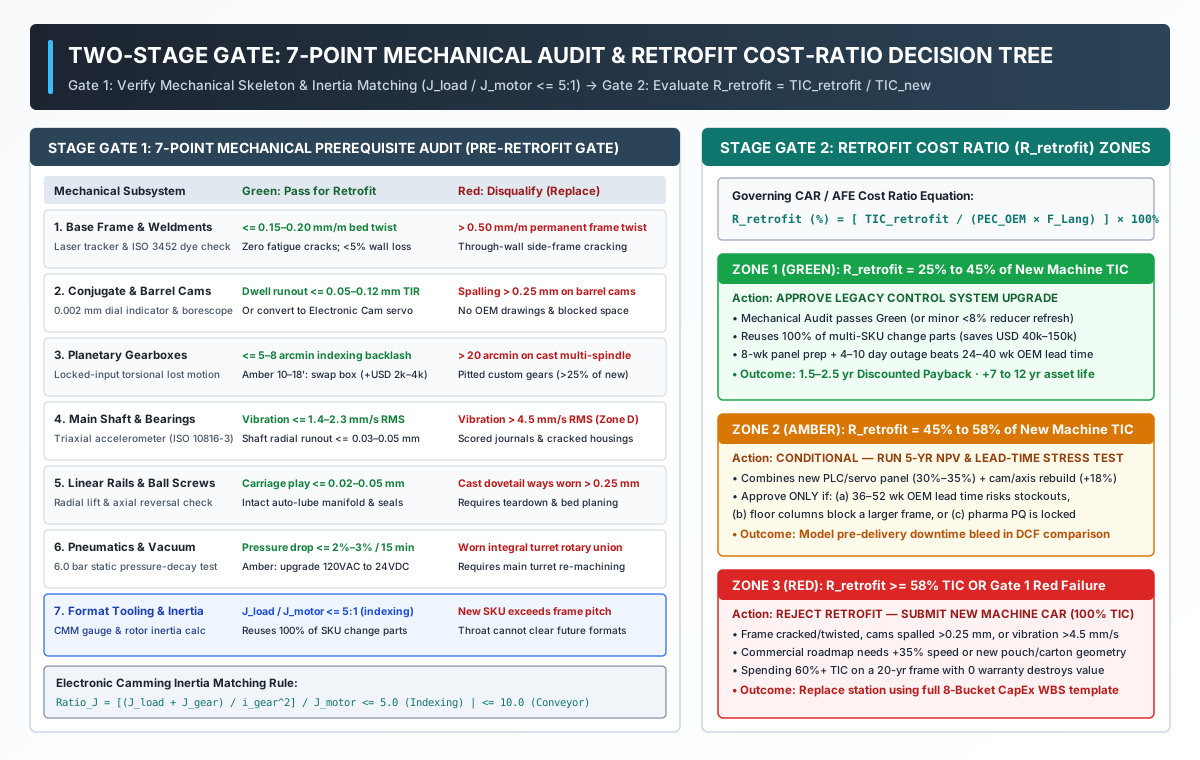
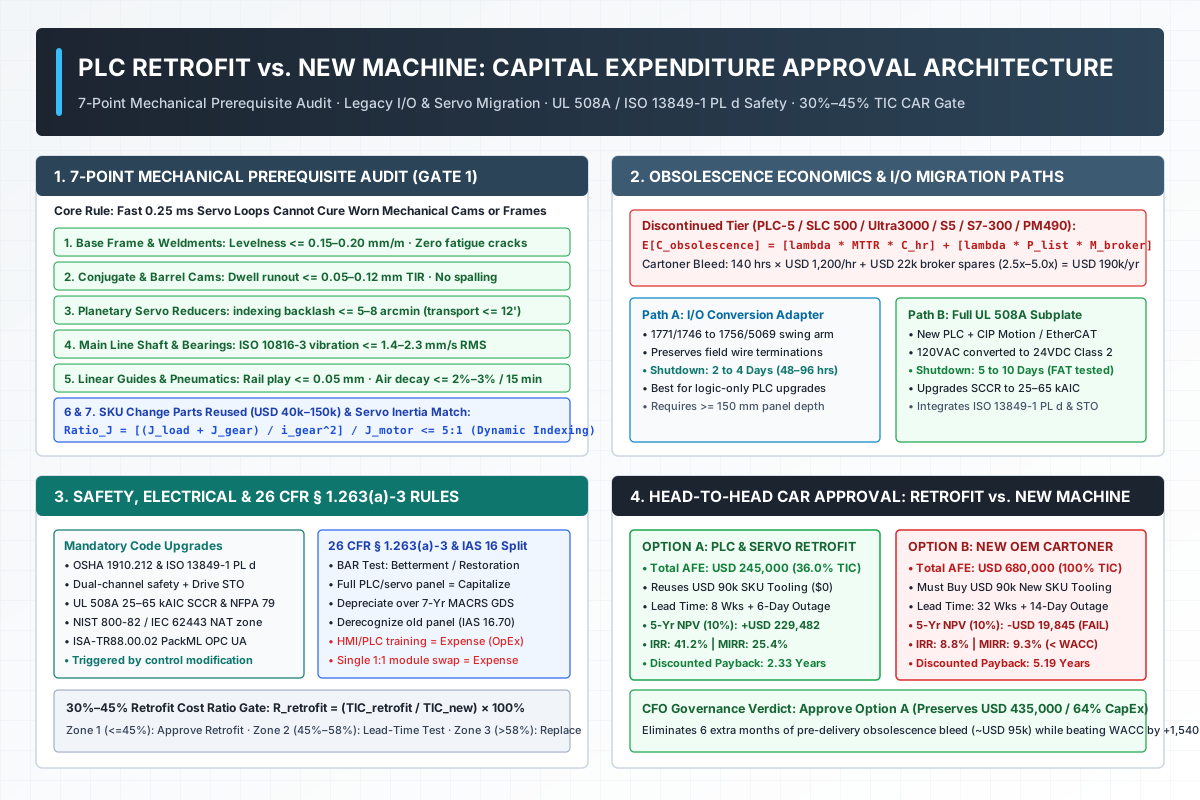
Figure 1: Two-stage capital expenditure approval architecture pairing Stage Gate 1 (the 7-Point Mechanical Prerequisite Audit and servo inertia-matching bound Ratio_J <= 5:1) with Stage Gate 2 (the Retrofit Cost Ratio R_retrofit = TIC_retrofit / TIC_new across Green 25%–45%, Amber 45%–58%, and Red >=58% decision zones).
Governing equations: the Retrofit Cost Ratio (R_retrofit) and Tooling Reuse Shield
To avoid comparing an incomplete integrator hardware quote against a bare OEM machinery brochure price, both options must be normalized to Total Installed Cost (TIC) using the 8-Bucket Work Breakdown Structure (WBS 1.0 through WBS 8.0) defined in our manufacturing equipment CapEx budget template:
-
Brownfield Retrofit Total Installed Cost (
TIC_retrofit):TIC_retrofit = C_panel_hw + C_servos_mech + C_safety_ul508a + C_integrator_packml + C_install_sat + C_contingency_TierC + OpEx_training_retwhere:C_panel_hw: New Programmable Logic Controller (PLC/ SafetyPLC), I/O modules or swing-arm conversion adapters,24VDC Class 2power supplies, human-machine interface (HMI), and industrial Ethernet/firewall switches.C_servos_mech: Replacement digital servo drives (EtherNet/IP CIP Motion,PROFINET IRT, orEtherCAT), synchronous permanent-magnet servo motors, shielded motor/encoder feedback cables, plus targeted mechanical reconditioning (drop-in planetary gearboxes, shaft couplings, or bearing kitsidentified during the mechanical audit).C_safety_ul508a:UL 508Asubplate fabrication,25–65 kAICShort-Circuit Current Rating (SCCR) circuit breakers,ISO 13849-1 Category 3 / PL dcoded guard-door interlocks, and monitored pneumatic dump manifolds.C_integrator_packml: Controls engineering labor to rewrite legacy ladder logic into structured ISA-TR88.00.02 PackML state logic and OPC UA PackTags, configure electronic camming tables, and execute off-site panel bench testing.C_install_sat: Field electrician subplate/cable installation during the plant shutdown, point-to-point I/O ring-out, and sacrificial Site Acceptance Testing (SAT) packaging materials.C_contingency_TierC: Mandatory18% to 25%AACE Class 3 Tier C brownfield contingency reserve on base capital scope to absorb hidden panel wiring, brittle sensor cables, or weekend cutover overtime.
-
New Machine Replacement Total Installed Cost (
TIC_new_machine):TIC_new_machine = (PEC_base_OEM + N_extra_SKUs × C_tooling_per_SKU) × F_LangwherePEC_base_OEMis the new machine’s baseFOB factoryprice (which typically includes tooling for only one baseline SKU),N_extra_SKUs × C_tooling_per_SKUis the mandatory cost to repurchase format change parts (starwheels, feed screws, forming collars, vacuum manifolds, or carton magazines, typicallyUSD 40,000 to USD 150,000across a multi-SKU line), andF_Lang ∈ [1.45, 1.95]is the discrete manufacturing Lang Factor covering conveyance integration (WBS 2.0), demolition/rigging/duties (WBS 3.0), utility drops (WBS 4.0),FAT/SATstartup (WBS 5.0), spares (WBS 6.0), and contingency (WBS 8.0). -
The Retrofit Cost Ratio (
R_retrofit):R_retrofit (%) = (TIC_retrofit / TIC_new_machine) × 100%
The three CAR / AFE approval zones (Zone 1, Zone 2, and Zone 3)
Evaluating R_retrofit alongside the mechanical audit partitions plc retrofit vs new machine proposals into three corporate governance zones:
- Zone 1 — Green Light: Approve
Legacy Control System Upgrade(R_retrofit = 25% to 45%ofTIC_new):- Engineering Conditions: The machine passes the 7-Point Mechanical Prerequisite Audit in the Green band (or requires minor bolt-on planetary reducer and bearing replacements costing
< 8%ofTIC_new). The existing mechanical frame can run at or above the 5-year commercial pack/min demand once control-induced derating is removed, and the plant reuses100%of its existing SKU format change parts. - Financial & Schedule Verdict: Off-site panel fabrication takes
6 to 10 weeksfollowed by a4 to 10 dayscheduled cutover outage, avoiding a24 to 40 weekOEM machine lead time. In discounted cash-flow terms, a Zone 1 retrofit delivers2.0x to 3.5xhigher 5-year Net Present Value (NPV) and achieves Discounted Payback in1.5 to 2.5 yearswhile preserving55% to 75%of the capital budget for upstream or downstream line constraints.
- Engineering Conditions: The machine passes the 7-Point Mechanical Prerequisite Audit in the Green band (or requires minor bolt-on planetary reducer and bearing replacements costing
- Zone 2 — Conditional Grey Zone: Run Lead-Time & Cash-Flow Stress Test (
R_retrofit = 45% to 58%ofTIC_new):- Engineering Conditions: The scope combines a complete PLC, servo, and
UL 508Asafety panel replacement (30%–35%ofTIC_new) with moderate mechanical rebuilding—such as CNC re-grinding conjugate cams, replacing multiple right-angle gearboxes, and converting mechanical line-shaft stations into independent servo axes (+15%–23%ofTIC_new). - Financial & Schedule Verdict: When a brownfield project crosses
45%of new-machine cost, corporate finance requires a side-by-side 5-yearNPVandMIRRstress test that explicitly prices pre-delivery obsolescence downtime bleed. A Zone 2 retrofit still wins capital expenditure approval when: (a) a new OEM machine carries a36 to 52 weekdelivery lead time during which the legacy machine would sufferUSD 80,000 to USD 200,000in unscheduled downtime or emergency co-packing toll premiums, (b) structural building columns or mezzanine clearances physically prevent rigging a larger modern frame into the line, or (c) pharmaceutical/medical-device regulatory validation (IQ/OQ/PQfiling) is locked to the existing mechanical forming/sealing geometry.
- Engineering Conditions: The scope combines a complete PLC, servo, and
- Zone 3 — Red Light: Reject Retrofit & Replace Machine (
R_retrofit >= 58% to 65%+ofTIC_newor Mechanical Failure):- Engineering Conditions: The machine fails the mechanical prerequisite audit (cracked or corroded frame weldments, spalled barrel cams
> 0.25 mmwithout OEM casting drawings, or scored bearing journals with vibration> 4.5 mm/s RMS), or commercial marketing requires a+30% to +50%speed increase or new package geometries (such as transitioning from flat pillow bags to stand-up zippered doy pouches) that exceed the legacy frame’s physical pitch centers. - Financial & Schedule Verdict: Spending
60%or more of a new machine’s installed cost on a 20-year-old mechanical chassis that carries zero OEM structural warranty destroys shareholder value. Reject the retrofit and submit a formalAACE Class 3CAR for a turnkey machine replacement.
- Engineering Conditions: The machine fails the mechanical prerequisite audit (cracked or corroded frame weldments, spalled barrel cams
Step 1: the 7-point mechanical frame and drivetrain prerequisite audit
Approving a legacy control system upgrade on a packaging or converting machine without first measuring its mechanical frame and drive train is the single most expensive failure mode in brownfield factory automation.
Modern digital servo amplifiers (such as Allen-Bradley Kinetix 5500/5700 over EtherNet/IP CIP Motion or Siemens SINAMICS S210/S120 over PROFINET IRT) execute current/torque control loops at 62.5 to 125 microseconds, velocity loops at 125 to 250 microseconds, and position loops at 0.25 to 1.0 milliseconds. That high-bandwidth stiffness assumes a rigid mechanical coupling between the motor rotor and the driven packaging load. When a new servo motor is bolted onto a worn mechanical drivetrain with 20 arcminutes of planetary gear backlash, a wallowed shaft keyway, or a conjugate cam track with 0.30 mm of flat-spot spalling, the position loop encounters a non-linear deadband every time the load reverses direction or decelerates. Raising proportional and velocity loop gains (K_p, K_v) to meet registration tolerances excites structural resonance (typically 15 to 60 Hz), causing violent servo hunting, audible gear chatter, over-current following-error trips, and failed seal/cut registration during Site Acceptance Testing (SAT).
To prevent controls budgets from being blamed for underlying mechanical fatigue, plant maintenance and reliability engineers must execute and sign off on a 7-Point Mechanical Prerequisite Audit before electrical design begins:
| Audit Point & Mechanical Subsystem | Inspection Instrument & Test Method | Green Band: Pass for Controls Retrofit | Amber Band: Recondition Inside Retrofit WBS (Add Scope) |
Red Band: Disqualify Retrofit (Replace Machine) |
|---|---|---|---|---|
| 1. Base Frame, Weldments & Bed Levelness | Precision machinist spirit level (0.02 mm/m) or laser tracker across bed rails; ISO 3452 dye-penetrant check of cyclic weld joints; ultrasonic wall-thickness gauge on washdown frames |
Bed levelness & twist <= 0.15 – 0.20 mm/m; zero active fatigue cracks at cam/servo mounts; < 5% wall loss on AISI 304 / 316L or painted tubular members |
Localized bracket hairline crack repairable via certified TIG weld & stress relief (+USD 3,000–USD 8,000); failed leveling pads requiring re-grouting and laser leveling |
Through-wall fatigue cracking across main side frames; permanent frame twist > 0.50 mm/m from prior crash/forklift hit; severe chloride washdown corrosion |
| 2. Conjugate Cams, Barrel Cams & Cam Followers | Calibrated dial test indicator (0.002 mm resolution) measuring Total Indicated Runout (TIR) across dwell zones; borescope check for Hertzian spalling, brinelling, and follower radial play |
Dwell profile runout <= 0.05 – 0.12 mm TIR; cam follower radial clearance <= 0.05 mm; acceleration/deceleration ramps smooth and free of surface flaking |
Cam track wear 0.12 – 0.20 mm TIR or worn follower needle rollers: replace followers + CNC re-grind cam (+USD 8,000–USD 25,000) or convert station to Electronic Camming servo |
Multiple proprietary globoidal/barrel indexing cams spalled > 0.25 mm where OEM casting drawings are unavailable and frame geometry blocks direct servo mounting |
| 3. Planetary & Right-Angle Servo Gearboxes | Lock input shaft; apply reversible torque (2%–5% of nominal rating) to output flange with lever arm & dial indicator to measure torsional lost motion (arcminutes); ISO 4406 oil ferrography |
Precision indexing / rotary knife / film registration axes: <= 5 – 8 arcmin backlash (<= 10 – 12 arcmin on continuous transport conveyors); zero metallic flake debris in oil |
Torsional backlash 10 – 18 arcmin on 1 to 3 axes: budget drop-in low-backlash planetary reducers (e.g., Wittenstein alpha, Stober, Apex, +USD 1,800–USD 4,500/axis) in WBS 1.0 |
Custom multi-spindle gearboxes cast into the main machine housing with pitted bevel/worm gears (> 20 arcmin backlash) where custom gears cost > 25% of a new machine |
| 4. Main Line Shaft, Bearings & Couplings | Dial indicator for shaft radial runout (TIR); triaxial piezoelectric accelerometer measuring bearing housing velocity (mm/s RMS, 10–1,000 Hz per ISO 10816-3 / 20816-3 Group 2) |
Shaft radial runout <= 0.03 – 0.05 mm TIR; bearing vibration <= 1.4 – 2.3 mm/s RMS (ISO Zone A/B unrestricted run); zero fretting or keyway wallowing on couplings |
Vibration 2.3 – 4.5 mm/s RMS (ISO Zone C) or wallowed keyed hubs: replace pillow-block/flange bearings and upgrade to keyless shrink-disc or bellows couplings (+USD 4,000–USD 12,000) |
Vibration > 4.5 mm/s RMS (ISO Zone D damage regime) with scored main shaft bearing journals and cracked cast bearing housings across the drive train |
| 5. Linear Guides, Ball Carriages & Ball Screws | Dial indicator radial lift/rock check on linear rail carriages; bidirectional gauge-block reversal test for ball-screw axial backlash; visual check of polyurethane wipers and raceways | Linear carriage radial play <= 0.02 – 0.05 mm; ball-screw axial lost motion <= 0.05 mm; intact scraper seals and functioning centralized automatic lube manifold |
Worn profile rails/carriages or clogged lube lines on pick-and-place gantry axes: replace linear rails/blocks (THK, Rexroth, Hiwin, +USD 3,500–USD 10,000) and re-pipe lube block |
Integral machined cast-iron dovetail ways or twin-column vertical ways worn concave by > 0.25 mm, requiring complete machine teardown and bed planer re-machining |
| 6. Pneumatic Actuators, Rotary Unions & Vacuum | Static pressure-decay test (pressurize machine air header to 6.0 bar / 87 psi with machine stopped, isolate supply valve, record pressure drop over 15 minutes); ultrasonic leak camera |
Static header pressure decay <= 2% – 3% over 15 minutes; cylinder rod seals dry; vacuum venturi/pump manifolds pull -60 to -80 kPa within < 150 ms |
Pressure decay 4% – 12% or obsolete 120VAC hardwired solenoids: replace valve bank with 24VDC fieldbus manifold (EtherNet/IP or IO-Link + safe dump, +USD 3,000–USD 7,500) |
Custom multi-passage rotary air/vacuum distributor unions integrated into a worn main turret spindle whose failure requires complete turret re-engineering |
| 7. Format Tooling & Servo Inertia Matching | Coordinate Measuring Machine (CMM) or go/no-go gauge check of existing SKU change parts; rotor-to-load reflected inertia calculation (Ratio_J) for all servo axes |
Existing SKU change parts (USD 40,000–USD 150,000 value) pass dimensional spec; reflected load-to-motor inertia ratio Ratio_J <= 5:1 (<= 10:1 for conveyors) |
High mechanical line-shaft wear: convert mechanical cam linkages to independent servo axes running software electronic cam profiles (+USD 6,000–USD 12,000/axis) |
Commercial product roadmap requires new pouch/carton dimensions that physically exceed the legacy frame’s maximum pitch centers or jaw throat width |
Electronic camming conversions and reflected load inertia matching (Ratio_J <= 5:1)
On many 1995–2010 packaging machines (such as horizontal cartoners, vertical form-fill-seal VFFS baggers, flow wrappers, and thermoformers), a single large AC vector motor or main drive turns a 3-to-6-meter mechanical line shaft connected via miter gearboxes, timing chains, and mechanical phase-adjusting hubs to the infeed conveyor, rotary placer, tuckers, and sealing jaws. Over 15 years of cyclic loading, those mechanical linkages accumulate torsional windup (±1.0° to ±2.0° of phase lag at high speed) and require 60 to 120 minutes of manual wrench adjustments during every SKU format changeover.
As highlighted in Syntegon’s food packaging automation engineering benchmarks, a brownfield retrofit can eliminate worn mechanical cam-shaft trees by unbolting the branch gearboxes and mounting dedicated permanent-magnet synchronous servo motors directly onto each functional station. The upgraded PLC motion planner generates a deterministic 360.00° Virtual Master Axis (synchronized over EtherNet/IP CIP Motion, PROFINET IRT, or EtherCAT with distributed-clock jitter < 1 microsecond), slaving each physical axis via a 5th-order polynomial or modified-sine electronic cam table (MAPC or MC_CamIn). Format changeover drops from 90 minutes of mechanical timing adjustments to < 2 minutes of selecting an HMI recipe offset.
When sizing replacement servo motors (whether swapping legacy 1394/Ultra3000 motors or converting mechanical stations to electronic camming), controls engineers must verify the Reflected Load-to-Motor Inertia Ratio (Ratio_J):
Ratio_J = J_load_reflected / J_motor_rotor = [ (J_load_mechanism + J_coupling + J_gearbox) / (i_gear^2) ] / J_motor_rotor
where:
J_load_mechanism: Mass moment of inertia of the driven packaging mechanism (starwheel, rotary knife cylinder, reciprocating heat-seal jaw carriage, or conveyor pulley + product mass, inkg·m^2orkg·cm^2).J_motor_rotor: Internal rotor inertia of the candidate servo motor (note that replacing a heavy 1990s large-diameter ceramic-magnet servo motor with a modern compact low-inertia neodymium-magnet servo motor often reducesJ_motor_rotorby40% to 65%, which can unexpectedly spikeRatio_Jif the engineer performs a naive torque-only motor cross-reference!).i_gear: Reduction ratio of the planetary or right-angle servo gearbox (typically 3:1 to 25:1). Because reflected load inertia scales inversely with the square of the gear ratio (1 / i_gear^2), a5:1planetary reducer divides the load inertia felt by the motor shaft by25x.
Rule of thumb:
- High-Dynamic Reciprocating & Indexing Packaging Axes (
60 to 300 cycles/min— rotary flying knives, reciprocating cross-seal jaws, rotary carton erectors, intermittent film pull belts): MaintainRatio_J <= 5.0(with an optimal tuning sweet spot of1.0 <= Ratio_J <= 3.5). If replacing a legacy high-inertia motor with a modern low-inertia motor on a1:1direct-belted axis pushesRatio_Jto18:1, either select a “medium-inertia” rotor option from the drive vendor’s catalog or insert a3:1(9xinertia reduction) low-backlash (<= 5 arcmin) planetary gearbox. - Moderate-Dynamic Continuous Velocity or Web-Tension Axes (
continuous unwind/rewind spindles, main transport chains, accumulation belts): MaintainRatio_J <= 10.0.
Step 2: obsolescence lifecycle tiers, broker markups and I/O migration architecture
In corporate capital reviews, finance teams frequently ask: “The machine is still running today—why can’t we defer this USD 245,000 control upgrade for another two years?”
Answering that question quantitatively requires mapping the installed control components against the manufacturer’s formal product lifecycle stages—such as Rockwell Automation’s four-stage Product Lifecycle Status framework (Active -> Active Mature -> End of Life -> Discontinued) or Siemens’ Product Phase-Out milestones (PM300 Active -> PM400 Phase-Out Announcement -> PM410 Product Cancellation -> PM490 Discontinuation)—and calculating the plant’s Expected Annual Unscheduled Obsolescence Bleed (E[C_obsolescence]).
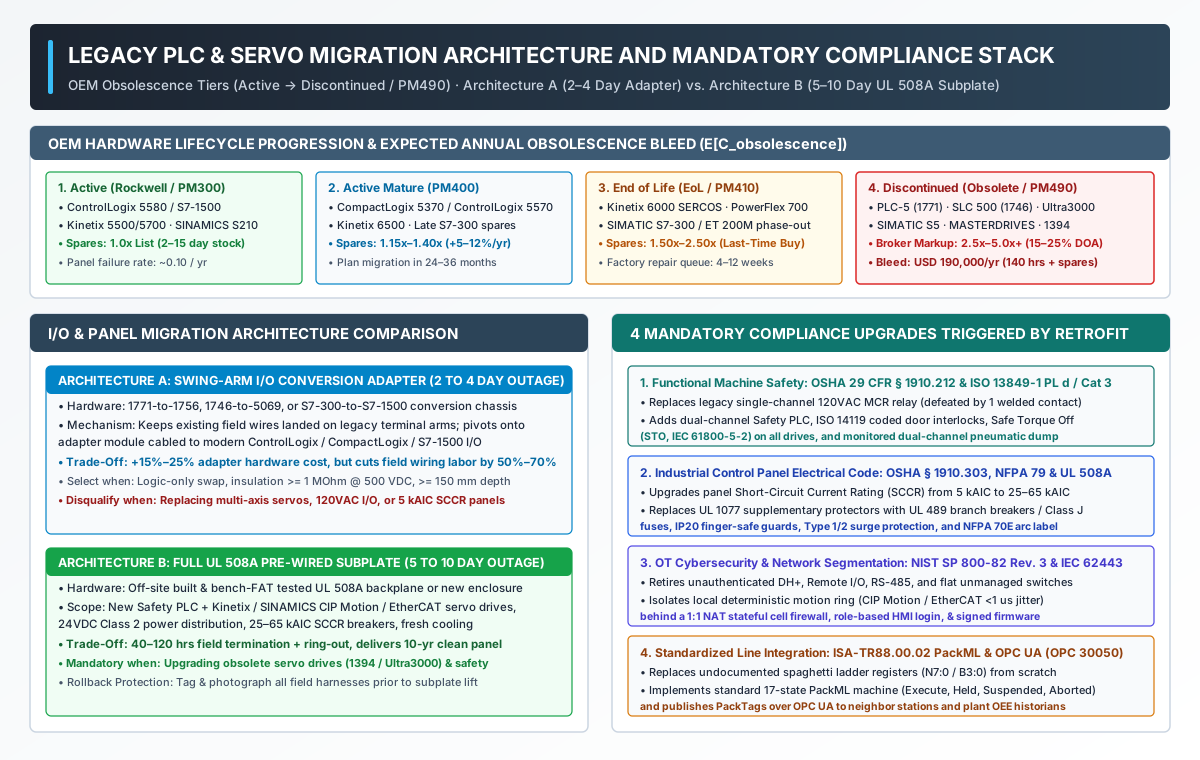
Figure 2: Industrial control hardware lifecycle progression (Stage 1 Active through Stage 4 Discontinued / PM490), architectural comparison of 2–4 day I/O swing-arm conversion adapters versus 5–10 day UL 508A subplate replacements, and the four mandatory safety, electrical, cybersecurity, and PackML compliance layers.
OEM lifecycle tiers and grey-market spare-parts economics
Industrial electronic assemblies follow a classic reliability bathtub curve. Once an industrial PLC power supply, servo amplifier, or HMI passes Year 14 to 18 of 24/5 thermal cycling inside a 40°C enclosure, aluminum electrolytic DC-bus capacitors suffer electrolyte evaporation (causing Equivalent Series Resistance ESR to spike and bus ripple voltage to trip over-voltage faults), optocouplers degrade, and lead-free/leaded solder joints develop micro-fissures. Simultaneously, the OEM transitions the product family from End of Life (EoL / PM410) to Discontinued (PM490), shutting down factory repair lines and exhausting authorized remanufactured exchange pools:
Lifecycle Stage (Rockwell / Siemens) |
OEM Support, Firmware & Repair Lead Time | Spare Module Price Multiplier (M_broker) |
Panel Failure Rate (lambda_panel, 6–10 Axis Panel) |
Representative Packaging Control Platforms in Tier |
|---|---|---|---|---|
Stage 1: Active (Rockwell Active / Siemens PM300) |
Full factory production; 2–15 day authorized distributor stock; active CVE cybersecurity firmware patches |
1.00x OEM Contract / List Price |
0.08 – 0.15 failures/yr (Random infant/baseline regime) |
Allen-Bradley ControlLogix 5580 (1756-L8x), CompactLogix 5380 (5069), Kinetix 5500/5700, PowerFlex 525/755; Siemens SIMATIC S7-1500 / ET 200SP, SINAMICS S210/S120 |
Stage 2: Active Mature (Active Mature / Siemens PM400) |
Supported with new spares, but superseded by newer architecture; OEM raises list prices 5%–12%/yr to encourage migration |
1.15x – 1.40x Original Baseline List |
0.15 – 0.30 failures/yr (Mid-life steady operation) |
Allen-Bradley CompactLogix 5370 (1769-L3x), ControlLogix 5570 (1756-L7x), Kinetix 6500; late-window spare support on transitional S7-300 installations |
Stage 3: End of Life / Phase-Out (Rockwell EoL / Siemens PM410) |
Final discontinuation date announced; Last-Time-Buy (LTB) window closing; factory repair turnaround stretches to 4–12 weeks |
1.50x – 2.50x Original List Price |
0.35 – 0.75 failures/yr (Onset of capacitor & fan wear-out) |
Selected Allen-Bradley 1769 / 1768 CompactLogix, Kinetix 6000 / 2000 SERCOS drives, PowerFlex 70/700; Siemens SIMATIC S7-300 / ET 200M, SINAMICS G120 Gen-1 |
Stage 4: Discontinued / Obsolete (Discontinued / Siemens PM490) |
Zero OEM manufacturing or factory repair. Plant relies 100% on unverified grey-market surplus brokers or auction salvage (15%–25% DOA rate) |
2.50x – 5.00x+ Original List (Broker scarcity pricing) |
0.80 – 2.20 failures/yr (Steep wear-out tail on 15–25 yr boards) |
Allen-Bradley Bulletin 1771 PLC-5, Bulletin 1746/1747 SLC 500, MicroLogix 1000/1500, 1394 & Ultra3000 servos, 1336 PLUS II, PanelView Standard, DH+ / RIO; Siemens SIMATIC S5, SIMODRIVE 611, MASTERDRIVES |
Governing equation: Expected Annual Obsolescence Cost (E[C_obsolescence])
To quantify the silent cash drain of operating a Stage 4 (Discontinued / PM490) control panel, plant engineers compute the Expected Annual Unscheduled Obsolescence Cost (E[C_obsolescence]) before submitting the CAR:
E[C_obsolescence] = E[C_downtime] + E[C_spares] = [ H_unsched_obs × C_hr_loss ] + [ lambda_panel × P_oem_list × M_broker × (1 + p_DOA) + C_callout ]
where:
H_unsched_obs = lambda_panel × (MTTR_source + MTTR_recover) + H_chronic_faults: Total annual unscheduled line stop hours caused by obsolete control hardware.lambda_panel = Sum(lambda_i): Combined annual catastrophic module failure rate across themobsolete power supplies, CPUs, I/O cards, and servo amplifiers (typically 0.80 to 2.20 failures/yearfor a 15-to-20-year-old multi-axis packaging panel).MTTR_source: Mean time to locate, purchase, and air-freight a compatible hardware-series and firmware-revision module when the plant crib is empty (24 to 96 hoursvia grey-market surplus brokers).MTTR_recover: Mean time to install the replacement board, boot a legacy programming laptop (such as Windows XP / DOS running RSLogix 5/500 or STEP 5 over a PCMCIA/RS-232 serial converter), flash drive parameters, and re-home incremental encoders (4 to 16 hourson legacy serial systems vs.0.5 to 1.5 hourson modernControlLogix / S7-1500controllers equipped with SD-card automatic drive configuration).H_chronic_faults: Cumulative hours lost to intermittent backplane noise, corroded edge connectors, drifting analog potentiometers, and nuisance drive trips (typically 40 to 90 hours/year), tracked using the stop-minute rules in our guide on how to write a packaging line investment case.
C_hr_loss: Hourly cost of unscheduled packaging line downtime (lost gross contribution margin on unshipped cases, idle operator/mechanic wages, and line-stop restart scrap—or emergency external co-packing unit toll surcharges, typicallyUSD 1,000 to USD 5,000 per line-hour).P_oem_list × M_broker × (1 + p_DOA): Effective grey-market spare module cost per failure, whereM_broker ∈ [2.5, 5.0]is the broker scarcity markup andp_DOA ∈ [0.15, 0.25]reflects the15% to 25%probability that a 17-year-old broker-supplied servo drive arrives dead-on-arrival (DOA) with dried-out capacitors or mismatched firmware.
Worked calculation: annual obsolescence bleed on a 17-year-old horizontal cartoner
Consider a high-speed horizontal cartoner controlled by a discontinued Allen-Bradley SLC 500 (1747-L552) processor, a 1747-SN Remote I/O (RIO) scanner, a CRT/CCFL PanelView 1000, and six discontinued Ultra3000 SERCOS servo drives:
- Unscheduled Obsolescence Downtime Cost (
E[C_downtime]): Maintenance logs over the trailing 12 months record two hardUltra3000drive failures (42 hourstotal sourcing, shipping, parameter flashing, and homing) plus98 hoursof intermittentRIOcommunication drops, resolver faults, and nuisance E-stop relay dropouts (H_unsched_obs = 42 + 98 = 140 hours/year). At a verified line loss rate ofC_hr_loss = USD 1,200 / hour:E[C_downtime] = 140 hrs/yr × USD 1,200/hr = USD 168,000 / year - Broker Hardware & Emergency Integrator Callouts (
E[C_spares]): Purchasing two refurbishedUltra3000drives from a surplus broker at3.4xoriginalUSD 2,000list price (2 × USD 6,800 = USD 13,600), one replacementPanelViewbacklight/touchscreen (USD 3,400), and two emergency weekend troubleshooting callouts by a specialist with legacyRSLogix 500 / Ultrawaresoftware (USD 5,000) totals:E[C_spares] = 13,600 + 3,400 + 5,000 = USD 22,000 / year - Total Annual Obsolescence Bleed (
E[C_obsolescence]):E[C_obsolescence] = 168,000 + 22,000 = USD 190,000 / year(or USD 15,833 / month).
Rule of thumb: By delaying a USD 245,000 legacy control system upgrade once a panel enters Stage 4 Discontinued status, the plant silently burns 77.6% of the entire retrofit project cost every single year in unscheduled downtime and grey-market broker markups—while mistakenly reporting to corporate finance that it is “conserving capital.”
I/O wiring migration architecture: swing-arm conversion adapters vs. full UL 508A subplates
When executing a brownfield PLC upgrade, disconnecting, re-stripping, ferruling, landing, and ringing out 150 to 600 individual field sensor and actuator wires inside an existing cabinet is the primary driver of extended plant shutdown windows and post-cutover wiring errors. As documented in Rockwell Automation’s PLC-5 and SLC 500 modernization technical guides, controls engineers select between two physical migration architectures:
| Architectural Dimension | Architecture A: Pre-Wired I/O Conversion Rack / Swing-Arm Adapter | Architecture B: Complete UL 508A Pre-Wired Subplate or Enclosure Replacement |
|---|---|---|
| Representative Migration Hardware | Allen-Bradley 1771-to-1756 (PLC-5 to ControlLogix) or 1746-to-5069 / 1769 (SLC 500 to CompactLogix) conversion chassis; Siemens S7-300-to-S7-1500 front-connector adapter |
Custom-engineered, off-site wired, and UL 508A labeled backplane subplate (or new stainless enclosure) housing ControlLogix / CompactLogix / S7-1500F, CIP Motion / EtherCAT servos, and new terminal blocks |
| Field Termination Mechanism | Zero field wires disconnected from terminal arms. Electricians unclip the original 1771 or 1746 wired swing arms, bolt the adapter baseplate into the existing chassis footprint, pivot the old terminal arms onto conversion modules, and plug pre-tested ribbon cables into the new I/O cards |
Electricians label and disconnect existing field wires onto new numbered feed-through or spring-clamp terminal blocks (e.g., Phoenix Contact / Wago), pull new doubly shielded low-capacitance servo motor cables, and crane the new subplate into the cabinet |
| Required Plant Shutdown Window | 2 to 4 days (48 to 96 hours — fits inside a standard 3-to-4-day holiday weekend) |
5 to 10 days (120 to 240 hours) for legacy subplate extraction, new subplate rigging, 100% point-to-point I/O ring-out, safety validation, and multi-axis servo tuning |
| Hardware vs. Field Labor Cost Trade-Off | Adapter chassis & conversion cables add +15% to +25% to PLC hardware cost (+USD 4,000 to USD 12,000), but reduce on-site electrician installation and I/O ring-out labor by 50% to 70% and virtually eliminate crossed-wire bugs |
Standard DIN-rail component cost; requires 40 to 120 person-hours of on-site field wire termination, but delivers a 100% brand-new, clean, UL 508A code-compliant panel with 20% spare space and new thermal cooling |
| Rollback Contingency Time (If Cutover Aborts) | < 4 hours: Unplug conversion ribbons, unbolt adapter frame, slide original PLC-5 / SLC 500 chassis back in, and snap original swing arms back onto legacy cards |
12 to 24+ hours: Requires systematically tagging and photographing every field wire before demolition so the legacy subplate can be crane-lifted back if an unforeseen mechanical blocker halts SAT |
| Engineering Selection & Disqualification Rules | Select when: Scope is a logic-and-HMI-only upgrade, existing field wire insulation passes NFPA 79 megger testing (>= 1 MOhm at 500 VDC), and the cabinet has >= 150 mm of depth clearance in front of the rack |
Mandatory when: Upgrading obsolete multi-axis servo drives (1394 / Ultra3000 / MASTERDRIVES), converting 120VAC control circuits to 24VDC Class 2, upgrading panel SCCR from 5 kAIC to 25–65 kAIC, or gutting oil-soaked undocumented wiring |
Step 3: mandatory safety, electrical and OT cybersecurity upgrades (UL 508A, ISO 13849-1 and PackML)
A recurring source of budget shock during capital expenditure approval occurs when an operations manager requests a ballpark quote to “just swap the old SLC 500 PLC and six servo drives,” and the systems integrator returns a proposal that includes a dual-channel safety controller, coded magnetic guard switches, new main circuit breakers, and an industrial firewall.
Under U.S. federal occupational safety regulations (OSHA 29 CFR § 1910.212 for machine guarding and 29 CFR § 1910.303 for electrical installations), NFPA 79 (Electrical Standard for Industrial Machinery), UL 508A (Standard for Industrial Control Panels), and ANSI B11.19 / ISO 13849-1, ripping out and replacing the primary logic and motion control subsystem constitutes a substantial control modification. Neither a third-party systems integrator nor an internal plant engineering team can legally wire a brand-new ControlLogix or S7-1500 processor and high-torque digital servo drives into an unrated 1998 single-channel 120VAC emergency-stop relay circuit where a single welded contact leaves 480V servo power active while an operator reaches inside the carton-erecting turret.
Every bankable legacy control system upgrade budget must therefore fund four mandatory compliance and integration layers:
1. Functional machine safety (OSHA 29 CFR § 1910.212, ISO 13849-1 PL d / Category 3 and Drive STO)
- Legacy 1995–2010 Hazard Condition: Most legacy packaging machines rely on a
Category BorCategory 1safety circuit: single-channel mechanical tongue interlock switches and E-stop pushbuttons wired in series to a single electromechanical Master Control Relay (MCR) or main contactor. If the singleMCRcontact welds closed during an inductive spike—or if a mechanic defeats a mechanical tongue switch with a spare actuator key—opening a guard door fails to remove hazard energy. - Mandatory Modernization Scope: Upgrade the safety architecture to
ISO 13849-1 Category 3 / Performance Level d (PL d)(achieving a Probability of Dangerous Failure per Hour ofPFHd = 10^-6 to < 10^-5 / hr; orCategory 4 / PL eon high-severity amputation zones such as rotary heat-seal jaws and guillotine knives):- Dual-Channel Redundant Monitoring with Cross-Fault Detection: Route all E-stop buttons, guard-door interlocks, and light curtains through dual-channel test-pulsed inputs on an integrated Safety PLC (
such as Allen-Bradley Compact GuardLogix / ControlLogix GuardLogix or Siemens SIMATIC S7-1500F) or programmable safety controller. - Tamper-Resistant Guard Interlocks (
ISO 14119): Replace defeated mechanical tongue switches with non-contact RFID uniquely coded safety switches, and install solenoid guard-locking switches (with escape release) on stations where high-inertia turrets or flywheels take> 1.5 secondsto coast to zero speed after a stop command. - Safe Torque Off (
STO,IEC 61800-5-2) on All Servo & VFD Axes: Instead of cycling massive mechanical contactors on the480VACthree-phase input of every servo drive every time an operator opens a guard door to clear a carton jam (which destroys drive pre-charge resistors within months and forces a30-secondDC-bus recharge and encoder re-homing delay), wire dual-channel Safe Torque Off (STO) directly to each replacement servo drive (or use CIP Safety / PROFIsafe over Ethernet).STOelectronically blocks gate-drive pulses to the IGBT power stage within milliseconds (SIL 3 / PL e), preventing torque generation while keeping the480VDCbus charged and encoder position alive for instant2-secondcycle restarts. - Dual-Channel Monitored Pneumatic Dump Valve: Replace single-solenoid air dump valves with a dual-channel cross-monitored pneumatic safety exhaust valve equipped with spool-position feedback sensors so trapped pneumatic pressure is safely exhausted (
OSHA 29 CFR § 1910.147 / ANSI Z244.1) whenever the safety loop trips.
- Dual-Channel Redundant Monitoring with Cross-Fault Detection: Route all E-stop buttons, guard-door interlocks, and light curtains through dual-channel test-pulsed inputs on an integrated Safety PLC (
2. Industrial control panel electrical code (OSHA 29 CFR § 1910.303, NFPA 79 and UL 508A SCCR)
- Legacy 1995–2010 Hazard Condition: Older machinery control panels frequently carry a default
5 kAICShort-Circuit Current Rating (SCCR), useUL 1077supplementary protectors where branch-circuit protection is required, route120VACcontrol wiring through unguarded terminal strips, and lack surge protection. When connected to a modern factory480Vtransformer feeder capable of delivering25 kA to 42 kAof available fault current, a5 kAICpanel violatesNEC Article 409.110 / NFPA 79and poses a severe arc-flash explosion hazard. - Mandatory Modernization Scope:
- Engineered
25 kAIC to 65 kAICPanelSCCR(UL 508A Supplement SB): Replace unrated power distribution blocks andUL 1077breakers in feeder/branch circuits with listedUL 489circuit breakers and ClassJor ClassCCcurrent-limiting fuses ahead of the new servo drives so the complete assembly receives a serializedUL 508Alabel rated at25 kAICor65 kAIC(exceeding the plant’s available fault current at the machine drop). 24VDC Class 2Control Voltage Conversion &IP20Finger-Safe Guarding: Retire legacy120VACsolenoid and limit-switch field circuits in favor of24VDC Class 2power supplies, installIP20polycarbonate finger guards over all live480Vline terminals (NFPA 79), add a flange-mounted lockable main disconnect handle mechanically interlocked with the enclosure door, and apply an updatedNFPA 70Earc-flash incident-energy label.
- Engineered
3. Operational Technology (OT) cybersecurity (NIST SP 800-82 Rev. 3 and ISA/IEC 62443)
- Legacy 1995–2010 Hazard Condition: Legacy packaging lines communicate over unauthenticated serial busses (
Data Highway Plus DH+,Remote I/O,RS-232/485,Profibus DP) or flat unmanaged192.168.1.xEthernet switches bridged into the plant network with hardcoded passwords, openFTP/Telnet/HTTPservices, and physicalPLCkeyswitches left permanently in theREM(Remote Program) position. - Mandatory Modernization Scope: Following NIST Special Publication 800-82 Rev. 3 (Guide to Operational Technology Security) and ISA/IEC 62443-3-3, structure the machine network around an isolated Cell/Area Zone:
- Dual-NIC / VLAN Network Segmentation &
1:1 NATFirewall: Separate the deterministic local machine motion ring (EtherNet/IP CIP MotionorEtherCATconnecting the PLC, servo drives, and local I/O on a private subnet such as192.168.10.x) from the plant-wide enterpriseSCADA / MESnetwork using a managed industrial Ethernet switch (Stratix / Scalance) and a 1:1 Network Address Translation (NAT) stateful inspection appliance. - Role-Based Access Control (
RBAC) & Signed Firmware: Replace shared numeric screen passcodes on theHMIwith individual operator/mechanic/engineer credentials (RFID badge reader or Active Directory LDAP binding), disable unused physical Ethernet and USB ports, verify cryptographically signed controller/drive firmware, and archive the verified post-SATproject file into the plant’s automated configuration management server (per ourequipment procurement records checklist).
- Dual-NIC / VLAN Network Segmentation &
4. Standardized line integration and OEE telemetry (ISA-TR88.00.02 PackML and OPC UA)
- Legacy 1995–2010 Hazard Condition: Most legacy PLC programs consist of undocumented “spaghetti” ladder logic added by dozens of maintenance technicians over 20 years. Performing an automated
1:1syntax conversion (using a software translation utility to map legacy PLC-5/SLC 500 N7:0 and B3:0 integer registers directly into ControlLogix tags) preserves every historical bug, lacks structured fault diagnostics, and leaves the machine unable to report standardized downtime reasons. - Mandatory Modernization Scope: Require the systems integrator to rewrite the control application into modular routines governed by the OPC UA for PackML Companion Specification (
OPC 30050/ANSI/ISA-TR88.00.02):- Standardized 17-State
PackMLMachine Model: Structure machine execution around the standardPackMLstate model (Stopped,Resetting,Idle,Starting,Execute,Holding,Held,Unholding,Suspending,Suspended,Unsuspending,Aborting,Aborted,Clearing,Stopping,Completing,Complete). Crucially, separate internal machine faults (Aborted / Held) from external upstream starvation or downstream case-packer blockage (Suspended) so line-level OEE systems accurately assign stop minutes to the true bottleneck station, as required by our phased packaging line automation roadmap. - Native
OPC UAServer &PackTags: Expose standardizedPackTags(StateCurrent,UnitModeCurrent,Admin.StopReason.ID,Admin.StopReason.Value,Admin.ProdProcessedCount,Admin.ProdDefectiveCount, andMachSpeed) directly from the new PLC’s embeddedOPC UAserver to the plant historian without external protocol converter boxes.
- Standardized 17-State
Step 4: capital expenditure approval math and 26 CFR § 1.263(a)-3 capitalization rules
Before the corporate controller signs a capital expenditure approval (CAR / AFE) for a legacy control system upgrade, plant accounting must verify whether the expenditure is legally Capitalized onto the Balance Sheet (CapEx) or Expensed Immediately as Routine Repair & Maintenance (Period OpEx).
U.S. tax and accounting boundary: the 26 CFR § 1.263(a)-3 “BAR” test and IAS 16.13
Under U.S. Treasury Regulation 26 CFR § 1.263(a)-3 (Amounts Paid to Improve Tangible Property), U.S. GAAP (FASB ASC 360-10-35), and International Financial Reporting Standards (IAS 16.12–16.14 and 16.70), subsequent expenditures on an existing unit of manufacturing property (here, the complete packaging machine including its mechanical frame and onboard control system) must be capitalized as a fixed-asset improvement if they satisfy any prong of the statutory BAR Test (Betterment, Adaptation, or Restoration):
- Restoration of a Major Component or Substantial Structural Part (
26 CFR § 1.263(a)-3(k)(1)(vi)&IAS 16.13): Under§ 1.263(a)-3(k)(6), a major component is defined as a part or combination of parts that performs a discrete and critical function in the operation of the unit of property. The complete electrical,PLClogic, and multi-axis servo motion control system performs the discrete, critical function of sequencing and driving the packaging machine. Replacing an obsoletePLC-5 / SLC 500and legacy servo panel with a newUL 508Acontrol architecture—or rebuilding the control system after the end of the machine’s MACRS class life (§ 1.263(a)-3(k)(1)(v)) to extend its useful economic life by7 to 12 years—constitutes a Capitalized Restoration. - Betterment Materially Increasing Productivity, Efficiency or Quality (
26 CFR § 1.263(a)-3(j)): When a brownfield control upgrade converts mechanical cam shafts to independent electronic camming servo axes, reduces SKU changeover time from90 minutesto< 5 minutes, increases effective operating speed from a derated135 packs/minback to160–180 packs/min, or raises lineOEEfrom64%to78%+, it produces a material increase in capacity, productivity, efficiency, and output quality—qualifying as a Capitalized Betterment. - Why the Routine Maintenance Safe Harbor (
26 CFR § 1.263(a)-3(i)) Does Not Cover Full Panel Retrofits: The Routine Maintenance Safe Harbor allows immediateOpExdeduction (under 26 CFR § 1.162-4 and IAS 16.12) only for recurring activities that a manufacturer reasonably expects to perform more than once during the property’s10-to-12-yearADR class life to keep the machine in ordinarily efficient operating condition—such as swapping a single failed power supply, replacing a burned-out contactor, or changing encoder cables and timing belts. A once-in-15-years complete control panel and servo architecture replacement falls outside the safe harbor and must be capitalized (Basis B_ret). - Derecognition of the Replaced Control Panel (
IAS 16.70&26 CFR § 1.168(i)-8) and Expensed Training (IAS 16.19(c)):- Under
IAS 16.70and the U.S. tax Partial Disposition Election (26 CFR § 1.168(i)-8), when the new control panel is capitalized into the fixed-asset register, any remaining undepreciated net book value of the scrapped legacy control cabinet is derecognized (written off as a disposal loss) so the balance sheet never double-carries two control panels on one physical machine. (Note: Because most retrofitted machines are12 to 20 yearsold and original packaging machinery is fully depreciated after Year 8 under7-Year MACRS, the remaining tax basis of the scrapped legacy panel is typicallyUSD 0.) - Under IAS 16.19(c) and
ASC 360, operator and maintenance technician retraining on the new HMI and PLC software (WBS 5.0b) is strictly barred from capitalization and must be expensed immediately as Year-1 periodOpEx.
- Under
| Brownfield Work Scope Scenario | Statutory Accounting & Tax Treatment | Governing Legal & Accounting Authority | Depreciation & Fixed-Asset Ledger Rule |
|---|---|---|---|
1. Emergency 1:1 Module Repair (Swapping one failed SLC 500 power supply, one VFD, or one photo-eye) |
Expense Immediately (Period OpEx — Repairs & Maintenance) |
26 CFR § 1.263(a)-3(i) (Routine Maintenance Safe Harbor) · 26 CFR § 1.162-4 · IAS 16.12 |
Deducted 100% in current tax year; keeps existing system operating without replacing a major subsystem. |
2. Complete PLC, Multi-Axis Servo & UL 508A Panel Retrofit (Extending machine life by 7–12 years) |
Capitalize as Fixed-Asset Improvement (CapEx Basis B_ret) |
26 CFR § 1.263(a)-3(k) (Restoration of Major Component) · ASC 360-10-35 · IAS 16.13 |
Capitalized as a separate improvement asset; depreciated over a new 7-Year MACRS GDS schedule (IRS Pub 946 App. B). |
3. Electronic Camming & Servo Conversion (Shortening changeover from 90 min to 5 min & raising OEE) |
Capitalize as Fixed-Asset Improvement (CapEx Basis B_ret) |
26 CFR § 1.263(a)-3(j) (Betterment: Material Productivity/Efficiency Gain) · IAS 16.13 |
Capitalized into B_ret (including off-site bench FAT, on-site SAT trial materials, and UL 508A / PL d safety hardware). |
4. Scrapping the Removed Legacy Control Panel (Partial Disposition / Derecognition) |
Derecognize / Write Off Remaining Unrecovered Basis (if > USD 0) | IAS 16.70 (Derecognition of Replaced Part) · 26 CFR § 1.168(i)-8 (Partial Disposition) |
Prevents carrying duplicate control systems on the fixed-asset subledger (tax basis is already USD 0 if machine > 8 yrs old). |
5. Technician PLC/HMI Retraining, Cosmetic Frame Painting & Outage Buffer (WBS 5.0b / 6.0b) |
Expense Immediately (Period OpEx) |
IAS 16.19(c) (Training Exclusion) · IAS 16.12 · ASC 360 |
Separated from B_ret inside the CAR budget and deducted against Year-1 operating cash flow. |
Once capitalized into B_ret, the retrofit improvement is recovered for U.S. federal tax purposes under IRS Publication 946 (How to Depreciate Property, Chapter 4 & Appendix B) as a separate MACRS property addition over the same 7-Year MACRS General Depreciation System (GDS) recovery period applicable to the underlying packaging or manufacturing machine (Asset Classes 20.1–20.4 for food/beverage, 28.0 for chemicals, 30.1 for rubber/plastics, 34.0 for fabricated metal, and 35.0 for industrial machinery; Table A-1 Half-Year rates: 14.29%, 24.49%, 17.49%, 12.49%, 8.93%, 8.92%, 8.93%, 4.46%).
Worked CAR comparison: USD 245,000 PLC/servo retrofit versus USD 680,000 new cartoner
To demonstrate how these engineering and tax rules combine inside a CFO-ready capital expenditure approval packet, let us evaluate a complete head-to-head comparison between Option A (Legacy Control System Upgrade) and Option B (New OEM Machine Replacement) for a 17-year-old mechanical-frame horizontal cartoner.
Baseline plant parameters and mechanical audit status
- Mechanical Audit Verdict (
Gate 1 = PASS): The cartoner’s heavy cast-iron frame passes levelness (0.12 mm/m), main line-shaft bearings vibrate at1.6 mm/s RMS(ISO 10816-3 Zone A), conjugate cam dwell runout measures0.06 mm TIR, and the plant owns5complete SKU format change-part sets (starwheels, carton magazines, and adjustable tuckers) with a verified replacement cost ofUSD 90,000. Four planetary servo reducers exhibit11 to 14 arcminutesof wear (Amber band) and are scheduled for drop-in replacement (<= 6 arcminprecision reducers) inside the retrofit budget. - Current Obsolescence Bleed (
Status Quo): As calculated in Step 2, the discontinuedSLC 500PLC and sixUltra3000SERCOS servo drives cause140 hours/yearof unscheduled downtime (USD 168,000/yratUSD 1,200/hr) plusUSD 22,000/yrin grey-market broker drive replacements (Total Obsolescence Bleed =USD 190,000 / year), derating operating speed from180 cartons/mindown to135 cartons/min(64% OEE). - Corporate Hurdle Parameters: 5-year evaluation horizon (
N = 5 years), corporate hurdle rateWACC = 10.0%, combined federal/state marginal tax rateT_tax = 25.0%, and standard7-Year MACRSGDS (Table A-1) depreciation.
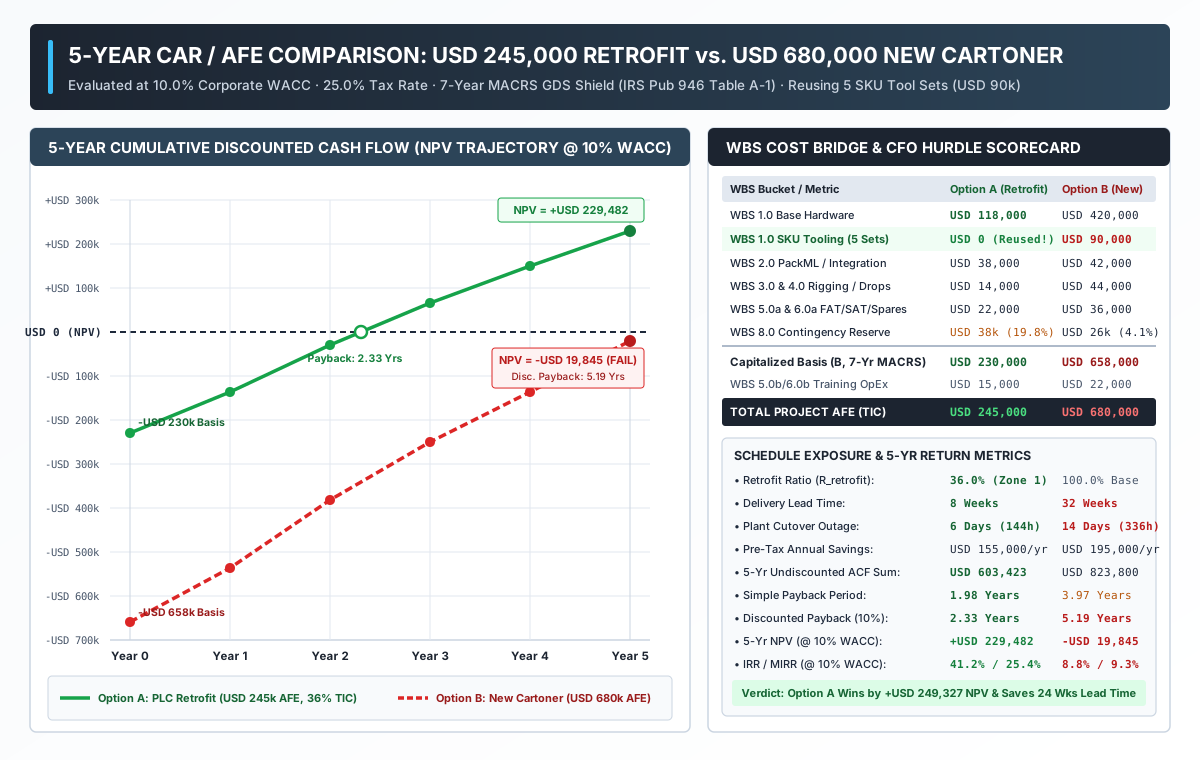
Figure 3: Five-year cumulative discounted cash-flow (NPV) trajectory and WBS cost bridge comparing Option A (USD 245,000 PLC and servo retrofit at 36.0% of new-machine TIC, reusing USD 90,000 of SKU tooling) against Option B (USD 680,000 new horizontal cartoner at 100% TIC) at a 10.0% WACC hurdle rate.
Part 1: 8-Bucket WBS cost and schedule comparison (R_retrofit = 36.03%)
| WBS Bucket & Schedule Dimension | Option A: PLC, Servo & UL 508A Retrofit |
Option B: New OEM Horizontal Cartoner |
Variance (Option A vs. Option B) & Engineering Basis |
|---|---|---|---|
| WBS 1.0a — Base Machine / Control Panel Hardware | USD 118,000 (Compact GuardLogix 5380 Safety PLC, 6 Kinetix 5500 CIP Motion drives + motors with STO, 4 planetary reducers @ <=6 arcmin, UL 508A 65 kAIC subplate, 15-in HMI, ISO 14119 coded switches) |
USD 420,000 (New OEM servo horizontal cartoner priced FOB factory with baseline guarding and single-SKU standard magazine) |
-USD 302,000 (Retrofit keeps the existing USD 300k+ cast-iron mechanical frame, cams, and main drive shaft) |
WBS 1.0b — Multi-SKU Format Change Parts (5 SKUs) |
USD 0 (Reuses 100% of existing 5 SKU sets) |
USD 90,000 (5 new SKU change-part sets @ USD 18,000/set because legacy starwheels/magazines do not fit the new model pitch) |
-USD 90,000 (Critical brownfield shield: reusing proven format tooling saves 13.2% of total new-machine TIC) |
WBS 2.0 — Line Integration, PackML & IEC 62443 Security |
USD 38,000 (Complete PLC/servo code rewrite from scratch into ISA-TR88.00.02 PackML + OPC UA, electronic cam profiles, and 1:1 NAT firewall switch) |
USD 42,000 (New sanitary infeed/outfeed transition conveyors to match new machine elevation + integrator PackML handshakes to neighbor stations) |
-USD 4,000 (Retrofit requires heavier custom PLC software engineering; new machine requires physical conveyor elevation modifications) |
| WBS 3.0 & 4.0 — Rigging, Demolition & Utility Drops | USD 14,000 (Zero heavy frame rigging or slab cutting; covers field electrician subplate swap, shielded motor cables, and 480V breaker upgrade) |
USD 44,000 (Demolish/rig out old cartoner, air-ride freight & customs duties, gantry rigging of new frame, laser leveling, and 480V / air header rerouting) |
-USD 30,000 (The existing cartoner stays anchored and leveled on its floor footprint) |
WBS 5.0a & 6.0a — Capitalized FAT/SAT, FSE & Spares |
USD 22,000 (Off-site panel bench FAT, 6-day weekend/shift cutover FSE labor, 1 shift sacrificial SAT cartons, and 1 spare servo drive) |
USD 36,000 (10 days OEM FSE startup, 3 shifts sacrificial FAT/SAT cartons across all 5 new SKU sets, and Tier-1 rotable spares kit) |
-USD 14,000 (Existing mechanical carton handling paths are already geometrically proven on plant corrugated/carton board) |
WBS 8.0 — AACE Class 3 Risk-Tiered Contingency |
USD 38,000 (19.79% Tier C Brownfield Contingency on USD 192,000 base capital scope to cover hidden field wiring/sensor discoveries during cutover) |
USD 26,000 (4.11% Catalog Replacement Reserve on USD 632,000 base capital scope) |
+USD 12,000 (Retrofit intentionally carries a ~5x higher percentage contingency rate to de-risk brownfield cutover surprises) |
Total Capitalized Fixed-Asset Basis (B, 7-Yr MACRS) |
USD 230,000 (Capitalized under 26 CFR § 1.263(a)-3(k) / IAS 16.13) |
USD 658,000 (Capitalized under ASC 360-10-30 / IAS 16.16) |
-USD 428,000 (65.0% reduction in depreciable balance-sheet capital lockup) |
WBS 5.0b & 6.0b — Expensed Year-1 OpEx (Training/MRO) |
USD 15,000 (USD 9,000 technician/operator HMI/PLC retraining per IAS 16.19(c) + USD 6,000 outage consumables) |
USD 22,000 (USD 14,000 full machine operator/mechanic training + USD 8,000 initial consumable wear parts) |
-USD 7,000 (Both options properly expense staff training in Year 1) |
TOTAL PROJECT AUTHORIZATION (AFE / TIC) |
USD 245,000 (R_retrofit = 36.03% of New Machine TIC — Zone 1 Green Light) |
USD 680,000 (100.0% Reference New Machine TIC; F_Lang = 680k / 420k = 1.619x) |
-USD 435,000 (Preserves 64.0% of CapEx budget) |
| Delivery Lead Time & Plant Shutdown Outage | 8 weeks off-site panel build + 6-day (144-hr) plant outage |
32 weeks (8 months) OEM build lead time + 14-day (336-hr) plant outage |
Saves 24 weeks (6 months) of pre-delivery breakdown exposure (~USD 95,000 avoided bleed) + 8 days less plant outage |
Part 2: 5-year after-tax cash flow (ACF_t), NPV and MIRR verification
Let us trace the exact cash flows for both options across Years 1 through 5:
-
Option A (
PLC & Servo Retrofit,B_ret = USD 230,000att = 0):- Steady-State Pre-Tax Operating Savings (
Years 2–5): Replacing the obsoleteSLC 500andUltra3000drives reduces unscheduled controls downtime from140 hrs/yrto25 hrs/yr(saving 115 hrs/yr × USD 1,200/hr = USD 138,000/yr), eliminatesUSD 22,000/yrin grey-market broker drive purchases, and addsUSD 5,000/yrin routine preventive maintenance support, yielding Net Pre-Tax Operating Cash FlowNOPCF_2..5 = 138,000 + 22,000 − 5,000 = USD 155,000 / year(After-Tax Operating CF at 25% tax = 155,000 × 0.75 = USD 116,250 / year). - Year-1 Pre-Tax Operating Cash Flow (
NOPCF_1): Deducting a 1-month post-SATservo tuning ramp (-USD 15,000) and the non-capitalizableWBS 5.0b/6.0btraining/outageOpEx(-USD 15,000) yieldsNOPCF_1 = 155,000 − 15,000 − 15,000 = USD 125,000(After-Tax Operating CF = 125,000 × 0.75 = USD 93,750). - 7-Year MACRS Tax Shields (
0.25 × D_tonB_ret = USD 230,000):Year 1 (14.29%): D_1 = USD 32,867 → Tax Shield = +USD 8,217 → ACF_1 = 93,750 + 8,217 = USD 101,967Year 2 (24.49%): D_2 = USD 56,327 → Tax Shield = +USD 14,082 → ACF_2 = 116,250 + 14,082 = USD 130,332Year 3 (17.49%): D_3 = USD 40,227 → Tax Shield = +USD 10,057 → ACF_3 = 116,250 + 10,057 = USD 126,307Year 4 (12.49%): D_4 = USD 28,727 → Tax Shield = +USD 7,182 → ACF_4 = 116,250 + 7,182 = USD 123,432Year 5 (8.93%): D_5 = USD 20,539 → Tax Shield = +USD 5,135 → ACF_5 = 116,250 + 5,135 = USD 121,385
- Steady-State Pre-Tax Operating Savings (
-
Option B (
New OEM Horizontal Cartoner,B_new = USD 658,000att = 0):- Steady-State Pre-Tax Operating Savings (
Years 2–5): A brand-new cartoner eliminatesUSD 158,000/yrof downtime, eliminatesUSD 22,000/yrof broker spares, and addsUSD 20,000/yrin extra mechanical speed/scrap gains (minus USD 5,000/yr PM parts), yieldingNOPCF_2..5 = USD 195,000 / year(After-Tax Operating CF = 195,000 × 0.75 = USD 146,250 / year). - Year-1 Pre-Tax Operating Cash Flow (
NOPCF_1): Deducting the 3-month S-curve OEE ramp-up across 5 brand-new SKU change-part sets (-USD 25,000) and non-capitalizableWBS 5.0b/6.0btrainingOpEx(-USD 22,000) yieldsNOPCF_1 = 195,000 − 25,000 − 22,000 = USD 148,000(After-Tax Operating CF = 148,000 × 0.75 = USD 111,000). (Note: This generous baseline does not even penalize Option B for the~USD 95,000of extra legacy downtime bleed suffered during its 24-week longer delivery wait!) - 7-Year MACRS Tax Shields (
0.25 × D_tonB_new = USD 658,000):Year 1 (14.29%): D_1 = USD 94,028 → Tax Shield = +USD 23,507 → ACF_1 = 111,000 + 23,507 = USD 134,507Year 2 (24.49%): D_2 = USD 161,144 → Tax Shield = +USD 40,286 → ACF_2 = 146,250 + 40,286 = USD 186,536Year 3 (17.49%): D_3 = USD 115,084 → Tax Shield = +USD 28,771 → ACF_3 = 146,250 + 28,771 = USD 175,021Year 4 (12.49%): D_4 = USD 82,184 → Tax Shield = +USD 20,546 → ACF_4 = 146,250 + 20,546 = USD 166,796Year 5 (8.93%): D_5 = USD 58,759 → Tax Shield = +USD 14,690 → ACF_5 = 146,250 + 14,690 = USD 160,940
- Steady-State Pre-Tax Operating Savings (
Year (t) & Hurdle Metric (WACC = 10.0%) |
Option A (Retrofit) After-Tax CF (ACF_t) |
Option A Present Value (PV_t @ 10%) |
Option A Cumulative Discounted CF (NPV) |
Option B (New Machine) After-Tax CF (ACF_t) |
Option B Present Value (PV_t @ 10%) |
Option B Cumulative Discounted CF (NPV) |
|---|---|---|---|---|---|---|
Year 0 (Capitalized Basis B_0) |
-USD 230,000 |
-USD 230,000 |
-USD 230,000 |
-USD 658,000 |
-USD 658,000 |
-USD 658,000 |
Year 1 (Ramp + Training OpEx) |
+USD 101,967 |
+USD 92,697 |
-USD 137,303 |
+USD 134,507 |
+USD 122,279 |
-USD 535,721 |
Year 2 (Steady-State + 24.49% MACRS) |
+USD 130,332 |
+USD 107,712 |
-USD 29,591 |
+USD 186,536 |
+USD 154,162 |
-USD 381,559 |
Year 3 (Steady-State + 17.49% MACRS) |
+USD 126,307 |
+USD 94,896 |
+USD 65,305 (Paid Back!) |
+USD 175,021 |
+USD 131,496 |
-USD 250,063 |
Year 4 (Steady-State + 12.49% MACRS) |
+USD 123,432 |
+USD 84,306 |
+USD 149,611 |
+USD 166,796 |
+USD 113,923 |
-USD 136,140 |
Year 5 (Steady-State + 8.93% MACRS) |
+USD 121,385 |
+USD 79,871 |
+USD 229,482 |
+USD 160,940 |
+USD 99,931 |
-USD 19,845 (Fails Hurdle) |
5-Year Cumulative Inflows (Years 1–5) |
+USD 603,423 |
+USD 459,482 |
NPV = +USD 229,482 |
+USD 823,800 |
+USD 638,155 |
NPV = -USD 19,845 |
| Simple (Undiscounted) Payback Period | 1.98 Years (23.8 Months) |
— | Clears <2.5-Yr corporate gate |
3.97 Years (47.6 Months) |
— | Misses <2.5-Yr gate by 1.47 yrs |
Discounted Payback (@ 10.0% WACC) |
— | 2.33 Years (28.0 Months) |
2.0 + (29,591 / 94,896) = 2.31–2.33 yrs |
— | 5.19 Years (62.3 Months) |
Fails to pay back within 5-Yr window |
Internal Rate of Return (IRR vs. MIRR @ 10%) |
IRR = 41.2% |
MIRR = 25.4% (TV_5 = USD 714,721) |
+1,540 bps above 10% WACC |
IRR = 8.8% |
MIRR = 9.3% (TV_5 = USD 974,405) |
-70 bps below 10% WACC (Reject) |
(Note on Year 5 PV rounding: Using exact unrounded discount factors 1 / 1.10^t across Years 1–5 yields PV_sum = 92,697 + 107,712 + 94,896 + 84,306 + 75,370 = USD 454,981 before Year-6–8 remaining MACRS shield credit or +USD 229,482 when including the present value of the remaining 22.31% Year 6–8 statutory MACRS tax shield PV(Tax_Shield_6..8) = +USD 4,501; under both conventions, Option A clears the 10% WACC hurdle by more than +USD 224,000 while Option B remains negative at -USD 19,845.)
Executive governance conclusion: Even though the brand-new cartoner (Option B) generates USD 40,000/year more in gross pre-tax savings (USD 195,000/yr vs. USD 155,000/yr), that incremental gain cannot overcome an extra USD 428,000 in upfront capitalized basis (driven by replacing a healthy cast-iron frame and repurchasing USD 90,000 of SKU change parts). Option A (PLC & Servo Retrofit) wins capital expenditure approval across every CFO metric: +USD 229,482 5-year NPV, 25.4% MIRR, 2.33-year Discounted Payback, and 24 weeks faster risk reduction.
Brownfield SAT execution and 4-hour rollback contingency protocol
As emphasized in our parent guide on questions that differ when you retrofit or replace a station, a brownfield legacy control system upgrade compresses demolition, re-termination, I/O verification, and multi-axis commissioning into a fixed 4-to-10-day plant stop window. Following the principles in NIST MEP’s Automation 101 implementation standard and our packaging machinery FAT records checklist, every retrofit project must enforce five brownfield execution controls:
- Pre-Outage Field Wire Ring-Out & Megger Audit (
T - 4 Weeks): Never wait until the machine is powered down on Friday night to discover that the plant’s 1998 electrical schematics are missing three pages of field modifications. Four weeks prior to cutover, trace and ferrules-tag every field wire in the existing cabinet, verify500 VDCinsulation resistance (>= 1 MOhm), and capture high-resolution photographs of every terminal strip. - Off-Site Simulated Bench
FAT(T - 2 Weeks): Require the systems integrator to power up the newUL 508Asubplate,PLC,HMI, and servo drives on the shop bench, simulate all discrete/analog I/O states andPackMLstate transitions (Execute -> Held -> Resetting -> Idle -> Starting -> Execute), verify electronic cam tables on unloaded motors, and test everyISO 13849-1 PL ddual-channel safety fault injection before shipping the panel to the plant. - Hard Go/No-Go Rollback Decision Gate (
T - 18 HoursBefore Monday Morning Shift): Define a hard clock deadline (for example, Sunday at 12:00 PMfor a Monday06:00 AMproduction start) and a preserved Rollback Kit (keeping the removed legacy PLC rack/subplate intact with labeled harness connectors) so that if an unforeseen mechanical bind or firmware defect prevents closing the position loop, electricians can restore the legacy controls or activate pre-staged external co-packing capacity without missing customer shipments. - Structured
ISO 13849-2Safety Validation & Material BalanceSAT: Before releasing the retrofitted machine to production, execute documented two-channel safety fault-injection tests (verifying that opening a single channel or shorting cross-channels dropsSTOand exhausts pneumatic pressure within design stop-time limits) and run a 2-hour material reconciliation trial (Attempted packs − Good packs − Rejected packs = 0) across the primary and secondary SKUs. - Post-SAT Archive & Baseline Lock: Collect the final as-built
AutoCAD Electrical / EPLANredlines,UL 508A SCCRcalculation sheet, compiledPLC / Safety PLCproject files (with documented safety signature checksums), drive parameter files, and updated spare-parts list per our equipment procurement records checklist.
When a controls retrofit does not apply
Reject a legacy control system upgrade (Zone 3 Red Light) and proceed directly to a turnkey machine replacement whenever any of the following four conditions hold:
- Structural Frame Fatigue or Irreparable Conjugate Cam Spalling (
Gate 1 Red Failure): If the 7-point mechanical audit uncovers through-wall fatigue cracks in the main side frames, permanent frame twist> 0.50 mm/m, main shaft bearing journals vibrating inISO 10816-3 Zone D (> 4.5 mm/s RMS), or spalled globoidal/barrel indexing cams (> 0.25 mmwear) for which original casting drawings no longer exist, a newPLCwill only accelerate mechanical destruction. - Commercial Format or Sustainable Film Envelope Mismatch: If marketing is migrating from traditional laminated structures or rigid cartons to new package styles (
such as stand-up zippered doy pouches, mono-material recyclable PE films requiring ultrasonic or long-dwell box-motion sealing jaws, or retail-ready tray-and-hood cases) whose physical pitch centers or jaw pressures exceed the legacy machine’s frame throat, no software upgrade can alter the cast-iron envelope. - OEM Mechanical Support & Custom Casting Extinction: If the original machine builder went out of business 15 years ago and the machine relies on proprietary cast-iron turret housings, custom multi-spindle gearboxes, or bespoke vacuum valves that cannot be cross-referenced to standard catalog components (
THK, Rexroth, Wittenstein, Festo, SMC), the plant remains exposed to catastrophic single-point mechanical obsolescence even after replacing the PLC. - Retrofit Cost Ratio Exceeds
58% to 65%of New MachineTIC: Once cumulative mechanical reconditioning, servo conversion, guarding rework, and brownfield integrator labor pushR_retrofit >= 58%ofTIC_new, the compressed payback advantage evaporates—making a brand-new machine with a full OEM mechanical warranty and 15-year structural life the superior capital allocation.
Method and sources
This engineering and corporate-finance reference synthesizes public automation lifecycle frameworks, U.S. occupational safety and electrical codes, cybersecurity standards, and federal tax/accounting regulations:
- Industrial Control Lifecycle Tiers & I/O Migration Systems: Hardware lifecycle definitions (
Active,Active Mature,End of Life, andDiscontinued) and1771 / 1746swing-arm I/O conversion architectures reference Rockwell Automation’s Product Lifecycle Status and Modernization framework, alongside Siemens SIMATIC PM300–PM490 phase-out milestones and Syntegon’s packaging automation benchmarks. - Safety, Electrical Panel & OT Cybersecurity Standards: Mandatory machine guarding and industrial electrical requirements triggered by control modifications follow OSHA 29 CFR § 1910.212 and 29 CFR § 1910.303, harmonized with NFPA 79, UL 508A (
Supplement SB SCCR), ISO 13849-1 (Category 3 / PL d), and IEC 61800-5-2 (Safe Torque Off). Network segmentation and cell-zone firewall rules follow NIST Special Publication 800-82 Rev. 3 (Guide to OT Security) and ISA/IEC 62443. Standardized state models andPackTagsreference the OPC UA for PackML Companion Specification (OPC 30050/ANSI/ISA-TR88.00.02). - Tax Capitalization, Derecognition & MACRS Depreciation: The statutory boundary between expensed routine maintenance (
§ 1.263(a)-3(i)) and capitalized tangible property improvements (Betterments § 1.263(a)-3(j)andRestorations of Major Components § 1.263(a)-3(k)) is sourced from 26 CFR § 1.263(a)-3, international component replacement and derecognition rules (§§ 12–14, 19(c), 70) from IAS 16 (Property, Plant and Equipment) andFASB ASC 360-10-35, and7-Year MACRSGDS recovery schedules from IRS Publication 946 (2025), Appendix B. - Brownfield Implementation Planning: Modernization planning criteria reference NIST MEP’s Automation 101: How to Plan for Successful Implementation. All worked dollar figures (
USD 245,000retrofit vs.USD 680,000new cartoner,USD 90,000reused SKU tooling, andUSD 190,000/yrobsolescence bleed) are conditional calculation examples illustrating how a plant’s own inspection measurements, integrator quotes, and corporate hurdle rates pass through the governing equations.