
An impressive demonstration can conceal packaging machinery failures when it lacks records proving the agreed requirements were met. A factory acceptance test (FAT) checklist should connect each requirement to the tested configuration, identified materials, raw results and an authorized disposition before shipment.
For a packaging machinery factory acceptance test, collect the approved requirement revision, machine and software identifiers, product and packaging lot details, signed test procedures, raw counts and defect records, interface and safety-test evidence, changeover observations, deviation closure and the shipment-release decision. Agree acceptance criteria, test duration and sampling before the run; this checklist assigns no universal pass/fail duration. Retain untested site conditions for installation-stage verification. A signature is useful only when its scope identifies what passed, what remains open and who has authority to release shipment.
Assemble a traceable FAT record pack before the trial
Start with a record index that links every test to the purchase specification and the actual machine configuration. A video without these references cannot establish which requirement was demonstrated.
Frain’s public FAT description describes witnessing equipment with the customer’s product, involving installation, operating and maintenance personnel, and retaining manuals and spare-parts information. This supports preparing the people, materials and handover records. Its service arrangements are supplier-specific; agree the scope of your own purchase separately.
Use this guide with the parent equipment procurement checklist to keep acceptance evidence connected to requirements and delivery. The checklist below is a working record list, with spaces for the plant to complete; it is not a certification form.
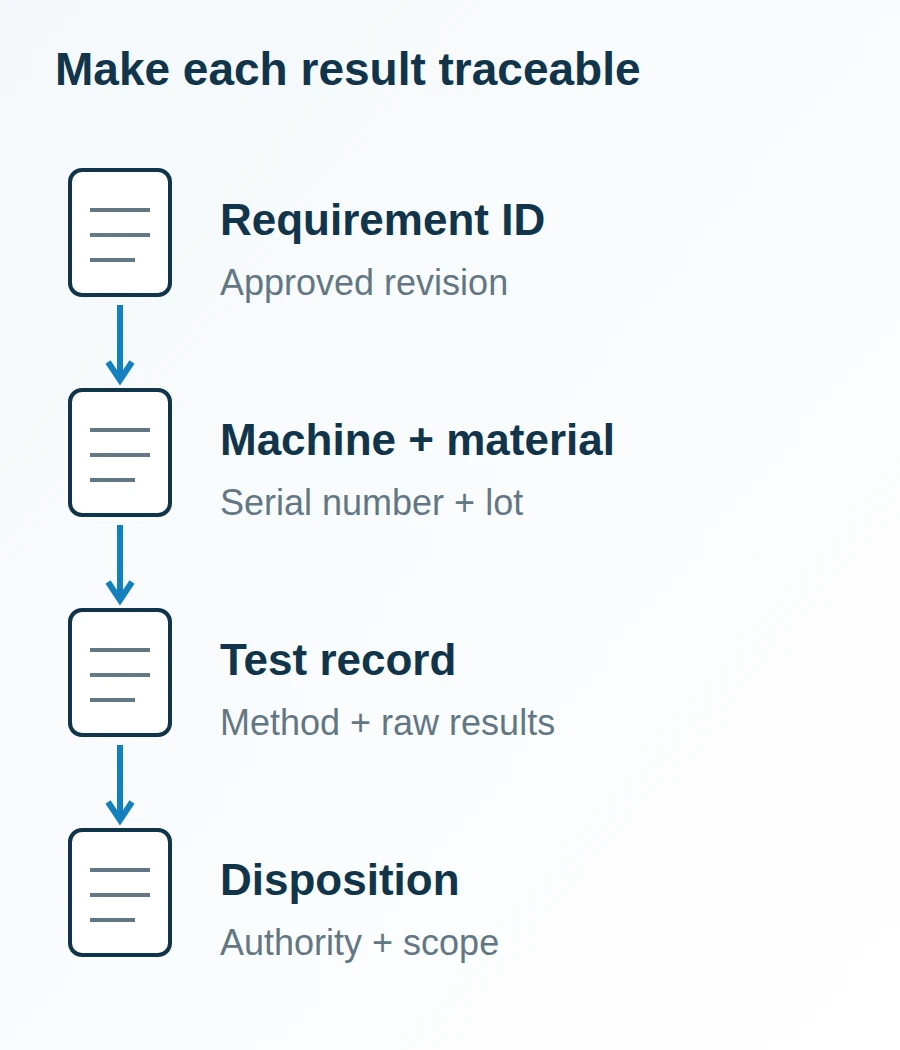
Traceability runs from the requirement to the tested configuration and result, rather than from a photograph to a general approval.
| Checklist record | What to enter or attach | Record ID / owner / status |
|---|---|---|
| Requirement baseline | Purchase specification, approved revision and applicable test IDs | ______ |
| Equipment identity | Machine serial number, included modules, tooling and drawing revisions | ______ |
| Controls baseline | Software versions, recipes, parameter backup and change history | ______ |
| Test procedure | Requirement reference, method, agreed criterion, sampling and duration | ______ |
| Witness and authority list | Buyer and supplier functions; who can accept deviations and release shipment | ______ |
| Material register | Product identity, packaging dimensions/specification, lot IDs and available quantities | ______ |
| Measurement records | Instrument ID, relevant calibration status and units used | ______ |
Agree who approves changes to the procedure once testing starts. Record the revision and reason rather than silently editing an acceptance limit after seeing the result. For product substitutes or limited sample quantities, identify exactly which claims remain unverified.
Keep raw results for packaging functions and failures
Record both normal output and the fault behavior specified in the protocol. A total output count can conceal rejects, repeated jams or a reject device that did not remove the defective pack.
| Packaging function | Records to collect | Dominant Failure Mode & Prevention |
|---|---|---|
| Feeding and transfer | Product orientation, misfeed log, jam location and corrective setup | Double feeds at a guide; trial representative product variation and retain the guide setting |
| Filling, closing or sealing | Actual settings, measured results, defect categories and method references | Contamination or inconsistent closure; use agreed product/materials and record the agreed quality checks |
| Coding and inspection | Code samples, challenged defect IDs, detection and physical rejection results | Correct alarm but failed rejection; reconcile each challenge with its final pack location |
| Line interfaces | Signal list, blocked/starved responses, stop/restart observations and included equipment | Neighbor continues feeding into a stopped machine; verify the agreed handshake and recovery sequence |
| Changeover and replenishment | Starting format, ending format, adjustments, waste and readiness definition | Wrong recipe or change part; identify parts and confirm the first conforming pack |
| Safety functions in scope | Approved procedure, responsible competent personnel, results and unresolved items | A protective function is unverified; retain the specified verification evidence and resolution |
Safety testing belongs to competent personnel using approved procedures. Keep access controls and protective functions in service; the record list does not authorize bypassing safeguards. Packaging quality methods must match the product and package specification. Do not apply an unrelated seal or leak-test limit just because another machine used it.
Retain original counter readings and timestamps, including stops and operator interventions. For each reported rate, state the pack unit and time basis. Identify any excluded setup or recovery time. A run on one film lot and format cannot establish performance for every material in the purchasing specification.
Reconcile test materials before accepting the totals
A material balance exposes missing or double-counted packs before counts are used as acceptance evidence. Use one unit and a defined boundary; track bulk product mass separately from primary packaging units and shipping cases.
Unexplained packaging units = issued units − conforming packed units − recorded scrap units − unused returned units.
Worked example — hypothetical reconciliation only: 500 issued units − 480 conforming units − 12 scrap units − 8 unused returned units = 0 unexplained units. These counts illustrate bookkeeping, not an acceptance sample size or a defect allowance.
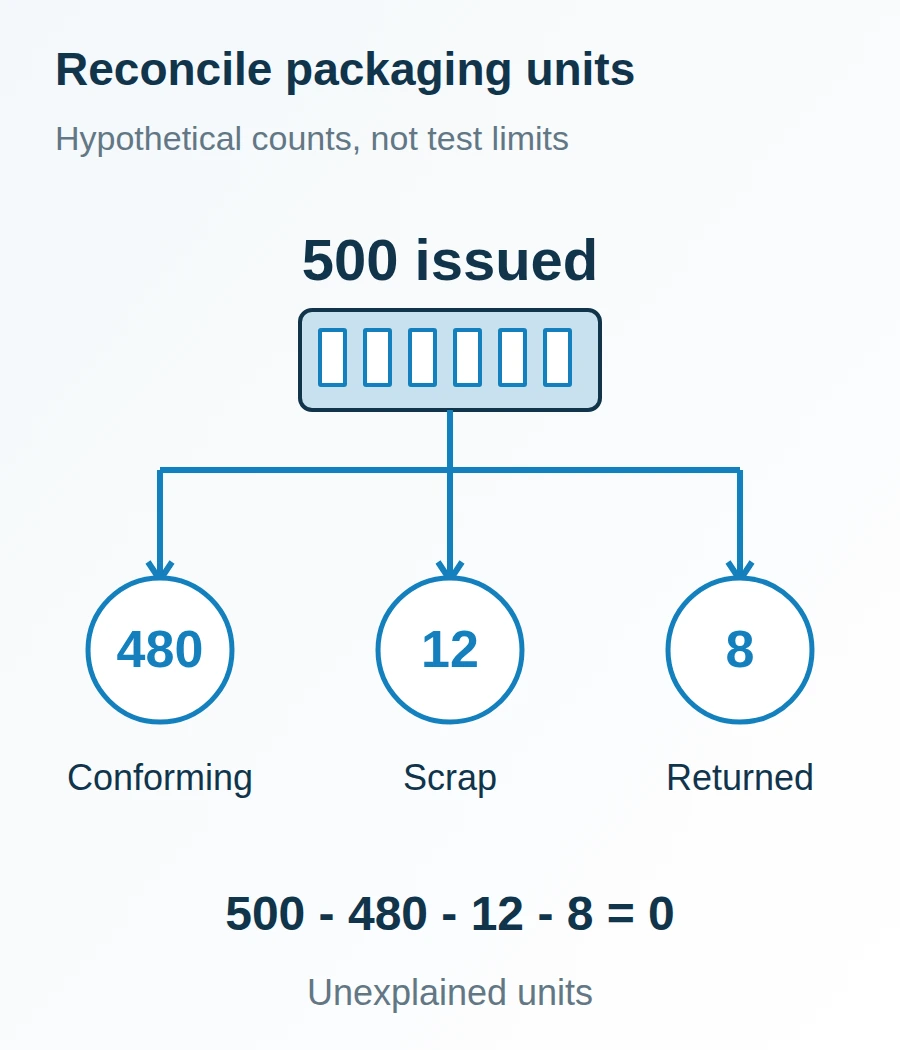
Every issued unit has one destination. Zero unexplained units does not prove acceptable seal quality or an acceptable scrap level.
If partially used rolls, destructive tests or retained samples fall outside those categories, add explicit categories and revise the equation before reconciling. Count retained samples once. Record how roll length or packaging weight was converted to units if direct counting was unavailable.
Threshold rule: if the number of unresolved deviations classified in the agreed protocol as shipment-blocking is greater than zero, hold shipment release. Resume the decision only after authorized disposition and the required retest records exist. This is a proposed purchasing control to agree in advance, not a universal statutory rule. A balanced material ledger cannot override an unmet quality or safety requirement.
Separate FAT disposition from installed-site verification
Close the factory test against its stated boundary, and carry site-dependent checks forward explicitly. Site acceptance must address the agreed conditions that could not be demonstrated at the supplier, such as installed utilities or interfaces with existing plant equipment.
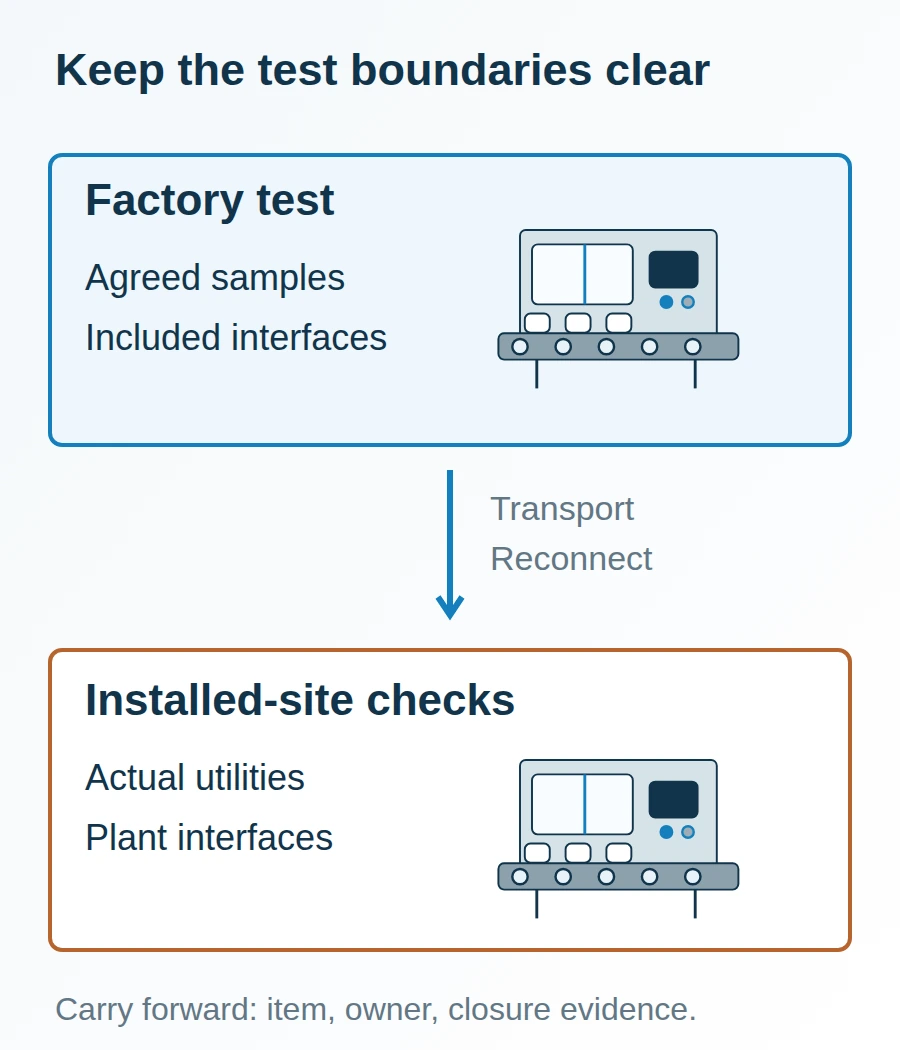
Transport and reconnection create a new configuration boundary. Carry-forward items need named owners and closure evidence.
| Closure record | What the signed record should show | Complete / record ID |
|---|---|---|
| Deviation log | Requirement, observed result, severity, owner and approved action | ______ |
| Retest evidence | Corrected configuration, repeated method, result and witness | ______ |
| Exclusions and site items | What was not tested, why, site owner and required evidence | ______ |
| Handover pack | Manuals, drawings, software backup, spare-parts list and training records | ______ |
| Shipment configuration | What ships and whether it matches the accepted revision | ______ |
| Release decision | Signatory authority, accepted scope, conditions and date | ______ |
Distinguish a correction with a successful retest from a buyer-approved concession. If a change affects another test, document the additional verification needed. Shipment release, payment milestones and final installed acceptance may be separate contractual decisions; keep their signatures and scope distinct.
Keep a time ledger for the capital review
Track the labor and machine time consumed by acceptance work so the capital case includes rework and delayed readiness. Leave allowances blank until the parties agree the protocol; supplier-specific visit guidance is not a performance acceptance duration.
| Time ledger item | Unit and evidence to retain | Where the record belongs |
|---|---|---|
| Procedure and material preparation | Engineering-hours; packing and sample-preparation hours | Procurement evidence pack |
| Witnessing and training | Attendee-hours by role; distinguish simultaneous activities | Procurement handover and training records |
| Test execution and changeovers | Actual machine minutes; timestamps, settings and waste | Raw FAT results |
| Fault investigation and retesting | Technician-hours and repeat material usage by deviation | Deviation and retest log |
| Site reconnection and readiness | Installation labor-hours and line-down minutes | Retrofit or replacement scope |
| Production cover while unavailable | Calendar delay, coordination-hours and temporary packing work | Packaging line investment case |
Do not add attendee-hours to machine minutes as if they were the same quantity. Track product loss, film, cartons, energy and replacement parts separately before applying internal unit costs. The ledger records the resources consumed; it does not imply a payback or a savings percentage.
Method and sources
This is an independent purchasing checklist. Frain’s public description supports product-based witnessing, participation by the operating and maintenance team, and handover preparation. The traceability tables, material-balance example, shipment-blocking threshold and time ledger are editorial record controls to agree with the buyer and supplier. They do not prescribe regulatory compliance or a universal test duration. The source was accessed on 19 October 2026. Last updated October 2026.