A co-packing toll that leaves out the operator wage and the line’s basis picks the wrong arrangement once annual volume crosses the breakeven. The May 2024 median hourly wage for packaging and filling machine operators is $19.67. Multiplied by 2,080 hours, that wage is $40,913.60, or 4.09 cents on one million packs, and it still excludes the machine. The contract-packing comparison names the two arrangements and does not set a price. This page is the arithmetic a price has to pass through. It is not a quotation, a tax position, or a machine rating.
The two bills use different units
| Record | What it prints | Dominant failure mode | Prevention |
|---|---|---|---|
| BLS USDL-25-0451, Table 1, May 2024, SOC 51-9111 | Employment 383,860. Mean hourly $20.98. Mean annual $43,630. Median hourly $19.67. | Treating $19.67 as a loaded plant rate. | The release says wages are straight-time gross pay. Overtime, shift differentials, and employer benefit cost are excluded. |
| Same release, footnote 1 | Annual wages multiply the hourly mean by 2,080 hours. | Calling $40,913.60 a published median annual wage. | $19.67 × 2,080 is this page’s product. BLS prints the mean annual, $43,630. |
| Same footnote, the rounding gap | 20.98 × 2,080 = 43,638.40. | Forcing the product to equal $43,630. | The printed mean annual is $8.40 lower. The hourly mean is rounded. |
| IRS Publication 946 (2025), Appendix B, asset class 20.4 | Manufacture of other food and kindred products. Class life 12 years. GDS (MACRS) 7 years. ADS 12 years. | Using 7 years on a line that is not that activity. | Classes 20.1, 20.2, and 20.3 are the other food classes. A non-food line looks up its own activity. |
| SEC exhibit, Toll Manufacturing Agreement effective 18 May 2009, Fermic and BioEnergy International | The tolling fee excludes raw materials. Materials are reimbursed at actual cost. Packaging and shipping are invoiced separately. Off-spec product reduces the fee pro rata and the raw-material cost of that product is refunded. Fees adjust with the US CPI from 1 January 2009. | Pasting that fermentation contract’s unprinted schedule onto a carton line. | Use the split. Keep the schedule’s unprinted dollars separate. The product is succinic acid, not a retail pack. |
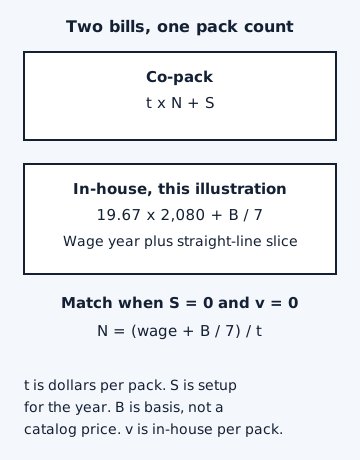
The general match, before those zeros, is N = (F − S) / (t − v), and only when t is greater than v. F is the in-house fixed bill for the year, S is the co-pack setup bill for the year, t is the toll per pack, and v is the in-house cash that still moves with each pack. If t is not above v, more volume does not flip the comparison.
Rule of thumb
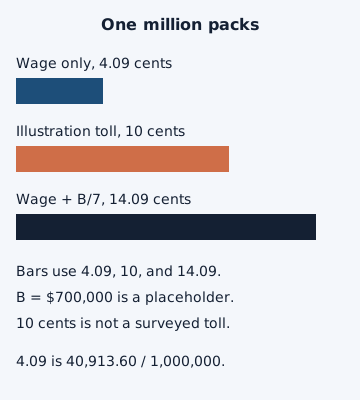
Rule of thumb. On one million packs, add 4.09 cents to the straight-line slice of basis before calling a toll “below the wage.” The 4.09 cents are $40,913.60 / 1,000,000. The slice is B / 7 / 1,000,000 for a line that actually falls in asset class 20.4, and B / 7 is not the MACRS half-year percentage. A toll that clears 4.09 cents and misses the slice still leaves the basis unpaid.
One million packs, with the basis written down
The packaging-line case leaves the plant’s own prices blank. The figures below are an illustration so the division can be checked. They are not a surveyed toll and not a catalog price.
Wage term, median hourly times the same 2,080 hours BLS uses to annualize the mean:
19.67 × 2,080 = 40,913.60 dollars.
Per pack at one million packs:
40,913.60 / 1,000,000 = 0.0409136 dollars, which is 4.09136 cents. Rounded to the hundredth of a cent, 4.09 cents. The unrounded quotient is the one that ties back to $40,913.60.
The printed mean annual, on the same million packs, is a different slice: 43,630 / 1,000,000 = 0.04363 dollars, or 4.363 cents. This page’s worked example stays on the median hourly product, so a high tail does not set the labor term. Employment of 383,860 counts full-time and part-time employees. It is not 383,860 people each working 2,080 hours.
Placeholder basis, so the second term is visible: B = $700,000. That number is not a machine price. Straight-line over the 7-year GDS recovery period:
700,000 / 7 = 100,000 dollars a year.
Per pack at one million:
100,000 / 1,000,000 = 0.10 dollars.
Wage plus that slice:
0.0409136 + 0.10 = 0.1409136 dollars per pack, or 14.09 cents.
At a placeholder toll of $0.10 per pack, setup of zero, and in-house variable of zero, the toll is above the wage-only 4.09 cents and below the 14.09 cents that include the placeholder basis. At one million packs, wage-only, the in-house bill is the smaller one. With the basis in the bill, the toll is the smaller one. The flip is the basis, not a change in the wage. The pack count where those two bills match is (40,913.60 + 100,000) / 0.10 = 1,409,136 packs. Below that count the $0.10 toll is the smaller bill. Above it, the illustration’s in-house bill is the smaller one.
Three years, undiscounted and at 8 percent
A three-year sketch pays the basis at the start, repeats the wage and the toll, ignores tax, salvage, setup, and benefits, and holds volume at one million packs. The discount factor for three end-of-year payments is:
a(r) = 1/(1+r) + 1/(1+r)² + 1/(1+r)³.
At r = 0, a = 3. At a placeholder toll of $0.10, the year’s toll is $100,000. Subtract the wage year:
100,000 − 40,913.60 = 59,086.40 dollars.
Undiscounted cover for the basis:
3 × 59,086.40 = 177,259.20 dollars.
The $700,000 placeholder is larger than $177,259.20. Three years of a 10 cent toll, after the median-wage year, do not pay for that basis.
The toll per pack that would cover $700,000 in those three undiscounted years, after the same wage, is:
(700,000 / 3 + 40,913.60) / 1,000,000 = 0.274246933 dollars.
At a chosen rate of 8 percent, which is not a surveyed cost of capital:
1/1.08 = 0.925925926
1/1.08² = 1/1.1664 = 0.857338820
1/1.08³ = 1/1.259712 = 0.793832241
Sum = 2.577096987.
Present value of the $59,086.40 gap:
2.577096987 × 59,086.40 = 152,271.38 dollars.
The toll that covers the $700,000 placeholder at that factor, after the wage, is:
(700,000 / 2.577096987 + 40,913.60) / 1,000,000 = 0.312537 dollars per pack.
Check the inner division: 700,000 / 2.577096987 = 271,623.46, and 271,623.46 + 40,913.60 = 312,537.06, which is $0.312537 per pack on one million. A plant that uses another rate replaces 0.08 and recomputes a(r). The capital-planning section is where that rate belongs beside the rest of the equipment case, not beside a co-packer’s brochure.
The toll, the material, and the minimum are three lines
The 18 May 2009 agreement between BioEnergy International, LLC and Fermic Sa de CV, filed as a toll manufacturing agreement, is a succinic-acid fermentation contract. It is not a carton co-packer. The body of the exhibit still separates the lines a packaging comparison mixes up.
Section 7.1 charges a fermentation tolling fee and a separation tolling fee, and it says the customer pays raw materials separately. Section 6.1 reimburses those raw materials at the actual cost Fermic paid, with the supplier invoices attached. The microorganism is supplied by the customer, not bought by the toller. Section 6.5 invoices packaging and shipping costs on their own. Section 4.3, excluding raw materials from the fermentation fee, reduces that fee in proportion to off-spec product and refunds the raw-material cost of the off-spec product. Section 7.3 moves the tolling fees with the US CPI, using 1 January 2009 as the baseline. The batch prices sit in schedules this page does not treat as a packaging rate.
A minimum order changes the formula only after the contract says what is billed. If the co-packer bills t × N + S for the packs made, N is the packs made. If the co-packer bills a minimum count M whenever the plant needs fewer than M, the co-pack bill at that need is t × M + S, and the comparison at N is not available. Section 3.3 of the Fermic agreement lets the customer choose how many developmental batches to run and points the batch cost at a schedule. A packaging minimum has to be that explicit about the billed unit. A yield loss the customer still pays for belongs in v or in an added material line. It does not disappear because the tolling fee excluded raw materials.
When this does not apply
- The line is not asset class 20.4. Publication 946’s 7-year GDS period is for manufacture of other food and kindred products. A different activity uses the class for that activity. B / 7 does not travel with the conveyor.
- The plant’s hour includes overtime, a shift differential, or the employer cost of benefits. USDL-25-0451 excludes those from the wage. The $19.67 line is then the wrong labor term.
- The billed minimum, the setup, or the material overage is unwritten. N = (F − S) / (t − v) cannot be evaluated, and a wage-only 4.09 cents is not a substitute.
- Someone treats $0.10, $0.274247, or $0.312537 as a market toll, or treats $700,000 as a machine price. All four are arithmetic on a placeholder. The BLS wage and the 7-year class are the sourced inputs.
- The decision is a tax deduction. The half-year MACRS percentage for 7-year property is not B / 7, and this page does not know the plant’s tax rate.
Methods and sources
Employment, the mean hourly wage, the mean annual wage, and the median hourly wage are Table 1 of BLS news release USDL-25-0451, Occupational Employment and Wages for May 2024, released 2 April 2025, for packaging and filling machine operators and tenders. The 2,080-hour rule and the wage exclusions are footnote 1 and the concepts note in that release. 19.67 × 2,080 = 40,913.60 and 20.98 × 2,080 = 43,638.40 are this page’s products. Asset class 20.4’s class life and recovery periods are Appendix B of IRS Publication 946 (2025). The tolling-fee split is the SEC exhibit of the agreement effective 18 May 2009 between BioEnergy International, LLC and Fermic Sa de CV. The 8 percent rate, the $0.10 toll, and the $700,000 basis are placeholders so the three-year factor can be checked. No co-packer was asked for a rate, and no packaging machine was priced.